
When you run vocal scales practice with only piano accompaniment, it is easy to stop at “sounds close enough.” Scale singing pitch feedback turns that moment into numbers and lines. Vocal Scales cycles through patterns, tempo, and key range, while a live pitch graph on the same screen tracks where your voice is right now. This article covers what to watch on the graph, how to use it for warmup, main practice, and song prep, and screen signals that often get misread. If note names and pitch feel unfamiliar, start with What Is Pitch in Music?.
What the Graph Tells You While You Sing Scales
Read the pitch graph along two axes. The vertical axis is note names (C, D, E…); the horizontal axis is time. When Vocal Scales tells you “this note now” (Now in the status row, or the highlighted step in the pattern strip), your sung line sitting on the same horizontal row means stable intonation. If it straddles a row above or below, you are roughly a semitone off. An empty or broken line usually points to mic level, sensitivity, or volume.
In music, intonation is not just “high or low” — it includes how accurately you hit a target note and how long you hold it (Wikipedia — Intonation (music)). Scales train that ability in short repeats. The graph is not judging “you today.” It is a memo of which notes your habits slip on.
I remember burning out on scales in a lesson room until my teacher said, “Pick one problem note and match it on piano.” Now the graph flags that note first. If F# in a D major scale keeps dipping to the row below, a short warmup centered on F# that day is smarter than another full run.
When the Note Changes — Attack, Sustain, and Intervals
Split each scale note into three chunks and the graph gets easier to read.
Attack
Right after the click and piano tone, check whether the line lands on the target row immediately or slides up from below. A slide often means late breath support or a vowel that is too wide, so pitch locks in late. That overlaps with breath and vowel issues in Why You Sing Flat.
Sustain
While you hold one note, see whether the line stays thin and flat or waves. Thin and flat means stable hold without vibrato; sagging toward a lower row at the end usually means air dropping out. If you add vibrato, check for an even ripple, as in What Is Vibrato and How Do You Develop It.
Interval
When you move to the next note, see whether the line jumps straight to the next row or skims a semitone row in between. Minor thirds (the third in major, the lowered third in natural minor) are narrow and often look like a slight dip or rise on the graph. They trip people up in scale warmups across genres.
Vocal Warmup Scales — Reading Today’s Condition on the Graph
Treat vocal warmup scales as a check that your voice is in a state where you can trust the graph — not as a push for high notes.
Step 1 — Level first
If Vocal Spectrum is open on the same dashboard, check whether the level is too low or clipping shows up often. If the graph is empty or choppy, nudge sensitivity or mic distance (How Browser-Based Pitch Detection Works). A quiet room usually gives a steadier line.
Step 2 — Major in a comfortable key
In Vocal Scales, use the Major preset, BPM 60–70, and a Root range of one key in your middle register (e.g. C4–C4). One ascent and descent is enough. If most notes are not “red flag” shapes on the graph, move on to main practice.
Step 3 — Minor and pentatonic for “color”
Switch Natural Minor and Major Pentatonic in the same key and watch how the graph changes. If the minor third pulls low, and your song is minor-based, matching that note a few times on Virtual Piano before repertoire is enough. Preset differences are covered more in A Singer's Guide to Scale Practice.
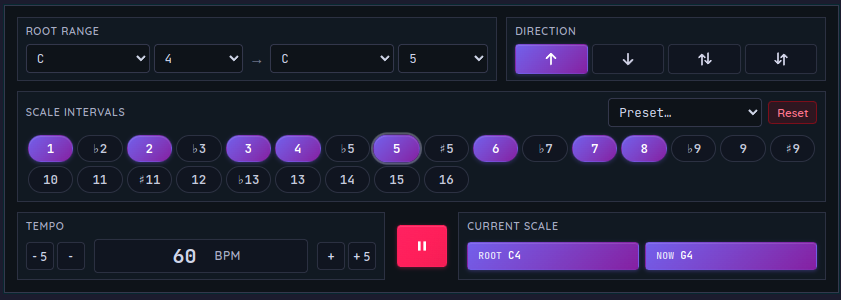
Narrow the key range and lower BPM first, then confirm the graph is trustworthy for today.
For pop or indie covers, pentatonic warmup alone is often enough. Musical theatre and classical work: watch whether legato vowels on seven-note scales shake the graph. On ballads, pick one or two long tones in a minor scale and check for a flat line — you get a preview of where pitch may fail in the take.
Main Practice — Aligning Pattern, Tempo, and the Graph
After warmup, widen Root range or raise BPM for vocal scales practice proper. Watch three signals on the Vocal Scales screen at once.
| Screen element | What it does | With the graph |
|---|---|---|
| Pattern strip | Which step you are on | When the highlight moves, does the line move to the next row? |
| Now | Target note and beat | Does the graph row match the Now note name? |
| Root / Next | Root for this pass / next key | When the key changes, does the line reset to the new root? |
Set tempo with Online Metronome at about 60–70% of the song BPM, then enter a similar number in Vocal Scales. If rhythm slips, the graph shows the line reaching the next note after the click. Turn up volume less; land the first vowel on the click first (How to Use a Metronome Effectively).
Practice two or three passes, restarting playback as needed; the tool does not have a repetition-count input. Between roots, key gap labels appear while the piano previews the next key. Now switches to gap text, so separate your sung line from what the tool is playing. Use the gap to breathe and prepare the next entry.
What to Watch Through Register Change (Chest to Head)
The same pattern gets jumpy where your voice changes color (chest toward head). SingWise — vocal registers and passaggio describes how muscle, air, and vowel shift together there.
In practice: halve BPM, turn on round-trip direction, and zoom in on two notes around the problem key. If the line bounces up and down, try a slightly rounder vowel (something closer to “oh” than a wide “ah”) before adding more air, then run the scale once more.
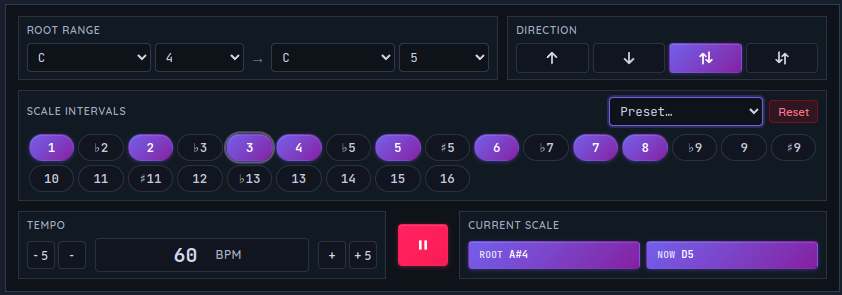
Slow down through register change and repeat only the two “jumpy” notes you see on the graph.
If you mapped your range today in Vocal Range Test, drop keys with lots of red or yellow from Root range, or practice a semitone down (What Is a Vocal Range Map?). On days when yesterday’s high notes will not cooperate, a rough graph is a fair reason to stay on mid-range patterns instead of forcing high scales.
When the Graph Looks Wrong — Avoid Misreading It
- The line sticks to one note but you are singing something else → room noise or speaker bleed. Use headphones or quiet the room (Hearing Your Own Voice While Recording).
- On high notes the line spikes up then drops → harmonics can register above the fundamental. Sing the same note softly twice and see if the pattern repeats.
- Scales look fine but the song does not → lyrics, consonants, and expression change vowel shape. Record 8–16 bars in Singing Recorder and compare the same graph on that section (Upload, Play Back, and Compare Vocal Takes in the Browser).
Music education often stresses that short, regular practice beats long, irregular blocks for retention (Music Teachers National Association). Fifteen minutes of scales with the graph leaves you with which note to shrink tomorrow, not just “I did a lot.”
Practice with MusicalBoard Vocal Scales
Open Vocal Scales, allow the mic, set preset, pattern, BPM, direction, and Root range at the top, and press play. The live pitch graph below uses the same family of analyzer as Vocal Pitch Monitor, so you get scale singing pitch feedback on one page without another tab. Laying out windows on the dashboard still works — see A 20-Minute Vocal Practice Session on the MusicalBoard Dashboard.
Suggested order (about 12–15 minutes)
- Major, BPM 65, narrow Root — condition check on the graph (3–4 min)
- Natural Minor or Pentatonic in today’s song key — note one or two problem notes (4–5 min)
- Widen Root by semitones with round-trip — slow passaggio only (4–5 min)
- Match problem notes on Virtual Piano, then a short Vocal Scales pattern built around those degrees
If Now and the pattern strip feel out of sync, lower BPM first. If it persists, reinforce “hear the target before you sing” from What Is Vocal Intonation with one reference note on Virtual Piano.
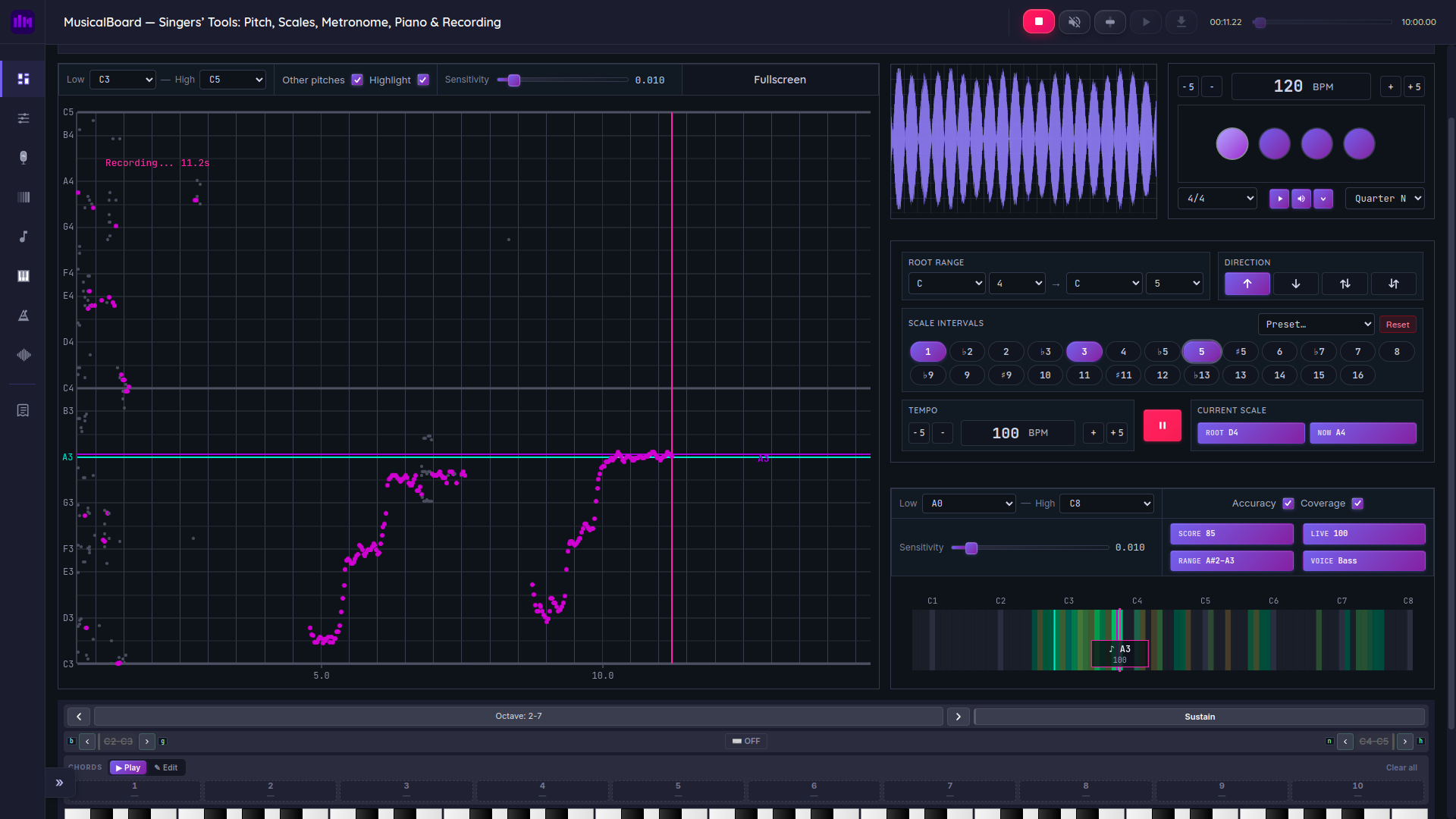
On the dashboard you can tile Vocal Scales beside the pitch graph; the dedicated Vocal Scales page gives the same feedback in one place.
When you finish, write one line from what the graph showed. Example: “D4→E4 dips low → tomorrow 3 minutes on E.” That line becomes tomorrow’s vocal warmup scales starting point.
References