
The biggest reason scale practice feels boring is that most singers run up and down without really knowing why they're doing it. Once you understand how major scales, natural minor, and pentatonic patterns actually work differently on your ear and your vocal muscles — and when to reach for each one — your practice sessions start to mean something. Vocal Scales lets you hear any of these patterns instantly in any key while a pitch graph shows you exactly where your intonation is landing. This post breaks down the structure and sound of each scale, how they map to different genres, and how to actually fold them into a real daily practice.
Why Scales Are Directly Tied to Singing Better
The reason vocal training keeps coming back to scales isn't just about memorizing notes. Singing is fundamentally a physical act. Your vocal folds and the surrounding muscles need to be precisely calibrated for each pitch shift — that's what makes a note feel stable and controlled rather than shaky or effortful. Scale practice is the repetitive training that teaches those muscles to internalize specific intervals so they stop being a guessing game.
Running scales across all keys matters more than most people think. The same pattern feels completely different depending on where it sits in your range. A major scale that flows easily in C can suddenly feel precarious in E — because the vowel shapes, the register transition points, and the breath support all shift when the key changes. Working through the same pattern in multiple keys forces you to notice which parts of your range are weak. That's where scales stop being a warmup and start being actual training.
There's another benefit that's easy to overlook. Scales consistently take you through your passaggio — the bridge between chest voice and head voice — and each pass through that zone, done slowly and carefully, smooths it out a little more. You're not going to fix a rough break in one session, but the cumulative effect of running that transition every day, without rushing through it, gradually reduces the tension at that gear shift. (SingWise — Understanding Vocal Registers and Passaggio)
Major, Minor, Pentatonic — Why They Actually Sound and Feel Different
Major Scale: The Foundation
A major scale fills one octave with 7 notes arranged in a specific interval pattern: whole–whole–half–whole–whole–whole–half. That particular spacing is why we hear it as "bright" and "stable." In C major it's C–D–E–F–G–A–B–C — the white keys on a piano, straight across.
For singers, the major scale matters beyond the fact that most Western pop and classical music is built on it. Training your vowel placement, breath support, and register transitions on major scale patterns means that when you're actually performing a song, your attention is free for expression rather than mechanics. In practice: start slow, go up and come back down without stopping, and once you're comfortable with the pattern, increase the tempo and run it as a continuous loop.
Minor Scale: Color and Emotional Range
Natural minor takes the major scale and lowers the 3rd, 6th, and 7th degrees by a half step. C natural minor is C–D–Eb–F–G–Ab–Bb–C. The "darker, more emotional" quality people associate with minor keys comes mostly from that lowered third — the minor third. Ballads, soul, and R&B lean heavily on minor tonality for exactly this reason.
Within the minor family there's also harmonic minor (where the 7th is raised back up to create a leading tone) and melodic minor (which raises the 6th and 7th going up and reverts to natural minor coming down). If you're working on musical theatre or classical repertoire, singing through melodic minor both ways is worth your time — your ear literally learns that the scale sounds different ascending versus descending, and that's a distinction that comes up constantly in that repertoire.
Pentatonic Scale: Five Notes, Maximum Flexibility
Pentatonic removes two notes from the 7-note scale. Major pentatonic drops the 4th and 7th from a major scale (C–D–E–G–A in C major). Minor pentatonic drops the 2nd and 6th from natural minor (C–Eb–F–G–Bb in C minor).
Losing two notes might not sound like a dramatic change, but it feels very different in practice. Most of the melismas and improvisational riffs you hear in pop, R&B, gospel, and CCM are built on pentatonic patterns. The two notes that get cut are the ones that create harmonic tension, so the five that remain can move freely over almost any chord without clashing. (Meredith Colby — Pentatonic Warm-Ups for Singers)
When you're first getting comfortable with pentatonic, prioritize listening over memorizing. Hear the pattern, sing along, and let those five notes settle into your body through repetition rather than forcing yourself to map out the theory.
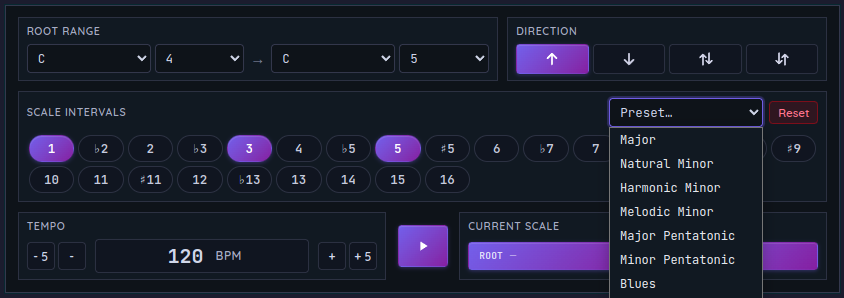
All three scale types covered above — major, minor, and pentatonic — are available as one-click presets in Vocal Scales, so you can hear and sing along immediately.
Scale and Genre — When to Use What
Understanding which scale fits which context gives you a clearer target for your practice sessions.
Classical and art song: 7-note major and minor scales are the foundation. The focus is sustaining consistent vowel shapes across the full range while connecting everything legato. Harmonic minor is useful for training the leading-tone sense that comes up constantly in classical phrases around the passaggio.
Pop and indie: Major pentatonic is the workhorse. Running a 5-note pattern through your comfortable key range before a session — up and back down — is genuinely sufficient warmup for most pop singers. When you're preparing a song with a high section, isolate the key that covers that range and drill the scale specifically there.
R&B, gospel, CCM: Minor pentatonic is central. Since melisma is built on these five notes, your scale practice shouldn't just be straight up-and-down runs. Add variations: skip every other note, reverse direction mid-pattern, linger on specific notes. That's how improvisational instincts actually develop — not from music theory, but from physical repetition of the vocabulary.
Musical theatre: Depends heavily on the style of the repertoire. Legit musical theatre follows the classical model — 7-note major and minor scales, legato emphasis. Pop-musical and CCM-adjacent styles skew pentatonic. Alternating between the two in the same key is a useful exercise for switching between those performance modes quickly.
An Actual Practice Routine — How to Use 15 Minutes Well
Step 1 — Pick your starting key (1 minute)
Check your voice today before deciding. Pull up Virtual Piano, play middle C (C4), and see how it feels. Don't start high. Pushing into your upper range before your voice has warmed up builds fatigue faster and tells you nothing useful.
Step 2 — Slow major scale to open (3–4 minutes)
In Vocal Scales, select the "Major" preset and set the BPM somewhere between 60 and 70. Press play: you get a four-beat count-in (with the first root on count 1), then the pattern runs with a click and piano on every step. Watch Root, Now, and Next in the status row — Now shows the pitch you should sing (or count/gap labels between keys) and the active step lights up in the pattern strip. Go all the way up and back down as one continuous phrase, listening for any wobble on individual notes. Keep Vocal Pitch Monitor open in another tab — seeing how much your pitch drifts above and below the target note in real time makes it much easier to catch problem spots. Do two passes on each key, then move up a half step.
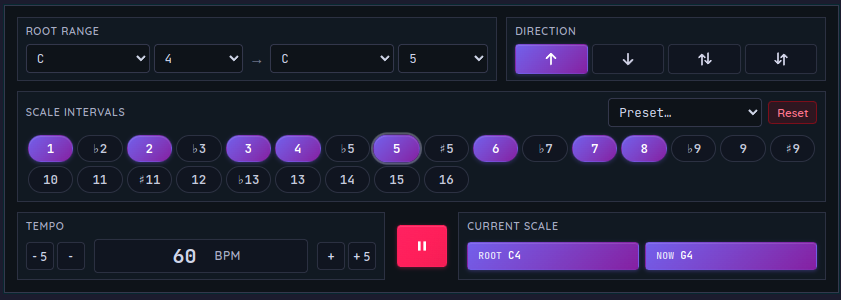
Matching the Major preset with a slow BPM, as described in Step 2, makes it easy to track each note within the root range as you sing along.
Step 3 — Switch to minor (3–4 minutes)
Stay in the same key and switch to the "Natural Minor" preset. Be intentional about noticing how the sound changes. Pay particular attention to the minor third — your pitch graph should land squarely on the target note there. That interval is narrow, and it's common early on to either undershoot it or overshoot it without noticing.
Step 4 — Pentatonic to close (4–5 minutes)
Switch to "Major Pentatonic" or "Minor Pentatonic" depending on what you're working toward. With only five notes, the gaps between them feel bigger, and those wider jumps are what make this a different physical challenge from 7-note scales. In this section, start experimenting: skip a few notes, hold some longer, try reversing direction mid-run. Bring the BPM up to 80–100 if you want to add a light rhythmic element to the session.
One thing to watch: if you feel your throat tightening or you're forcing any note, slow down or drop the key immediately. Practice gains come from repeating things correctly and comfortably — not from grinding through difficult high notes.
How to Work on the Passaggio Specifically
When you're using scales to train the chest-to-head voice transition, speed is your biggest obstacle. If you fly through the break, your body never registers that anything needs to change. Slow down, stay on each note, and actually pay attention to what's happening at that point in your range.
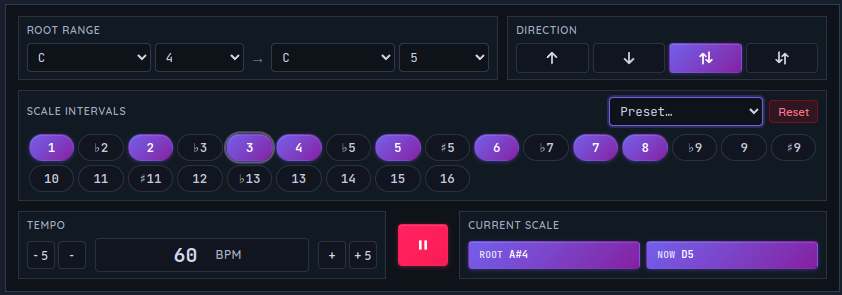
Using round-trip direction with a low BPM lets you move through the passaggio slowly instead of skipping over it. Between chromatic keys, a short key gap (clicks plus the next root preview) gives you a moment to reset before the new scale starts.
In practice: run a major scale at a moderate tempo and, as you approach your break, deliberately cut the speed in half. Watch the pitch graph at those notes — is it hitting the target steadily, or does the line jump around? Is the tone quality shifting abruptly? If the transition feels rough, try rounding your vowel slightly — moving from an open "ah" toward something closer to "oh" often releases some of the muscular tension right there.
Recording this section with Singing Recorder and listening back is worth the effort. When you're singing, bone conduction makes your own voice sound rounder and more controlled to yourself than it actually is. Listening to a recording of just that transition zone gives you an honest picture of whether the break is as rough as it feels — or sometimes, whether it's actually smoother than you thought.
Using MusicalBoard Vocal Scales in Practice
Vocal Scales lets you set the root range, BPM, and direction (ascending, descending, or both), and switch between major, minor, pentatonic, blues, and modal presets in a single click. You can also build a custom pattern in the strip — ordered degrees, duplicates allowed — not only fixed up-and-down shapes. Piano samples play each step on the beat (with a built-in click, separate from the Metronome page), and a count-in plus a four-beat key gap between chromatic roots help you sing in time when the key changes. Root, Now, and Next tell you which key you're in, what to sing now, and what's coming up.
Running Vocal Scales alongside Vocal Pitch Monitor in a second tab creates a feedback loop where your ears and eyes are getting information simultaneously — you hear the target and see in real time where your voice is actually landing relative to it. When you notice a specific note in a specific key consistently showing up shaky on the graph, that's your practice target for the week. No guesswork.
Between sessions, Online Metronome keeps your tempo honest, and finishing with Vocal Range Test shows you a color-coded map of which parts of your range are responding and which ones still need work.
The point where scales start to feel tedious is usually when it seems like you're just repeating something you already know. When that happens, try a preset you've never used before, or take a familiar pattern and start it in a key you've never really spent time in. Your ear has to work harder to process unfamiliar interval relationships — and that engagement is exactly what keeps the practice from going on autopilot.