
If you've ever been told your pitch is low, you know how confusing it can feel. You're convinced you're hitting the note, but then you play back the recording and the whole thing sounds like it's drooping — or you notice that the higher you go, the further under the pitch you fall. This post breaks down the three main reasons singers go flat and how to actually fix each one. Using a tool like Vocal Pitch Monitor — which shows your pitch in real time as you sing — makes it a lot easier to see exactly where things are going wrong instead of just guessing.
You Hear Yourself Lower Than You Actually Sound
This is probably the most overlooked cause of chronic flatness. When you sing, the voice you hear isn't the same one everyone else hears. On top of the sound traveling through the air to your ears, the vibrations from your vocal cords travel directly through your skull bones to your inner ear. That pathway is called bone conduction, and because bone transmits low frequencies more efficiently than air, your own voice always sounds richer and lower to you than it does on a recording.
According to Wikipedia's entry on bone conduction, the skull conducts lower frequencies more readily than air does, which is why people tend to perceive their own voices as fuller and deeper than they really are. That's the whole reason your voice sounds so foreign to you on a recording — you've never actually heard what other people hear.
The practical consequence for singing is real. If you're relying purely on your ears to find the note, the spot that "feels right" might actually sit slightly below the target pitch. Keep practicing that way and the flatness just gets baked in as a habit. To fix it, you need an external reference that doesn't depend on your ears alone.
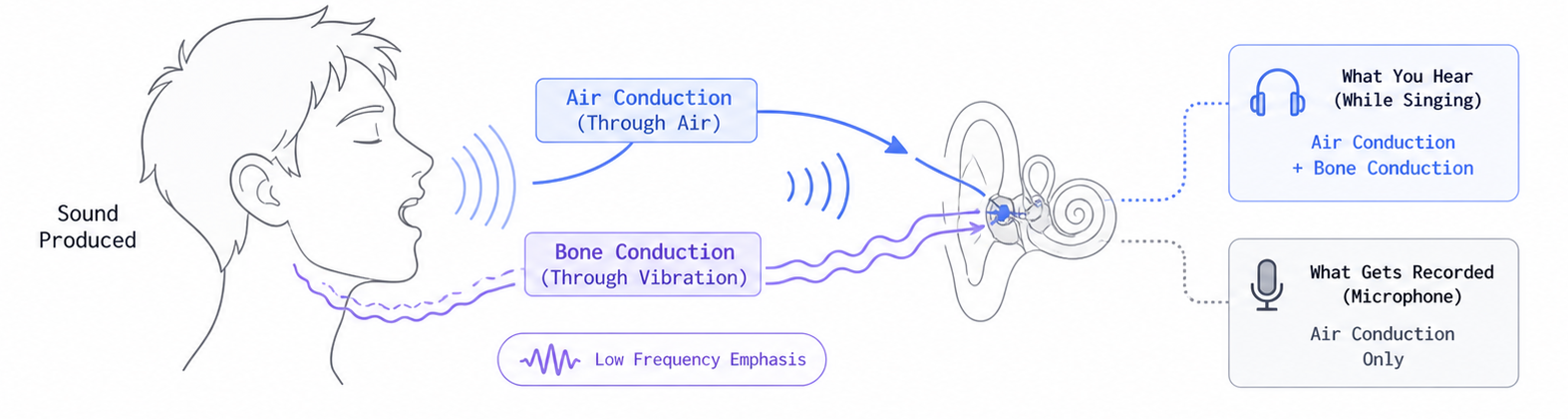
What you hear when you sing (air conduction + bone conduction) and what ends up on a recording (air conduction only) are genuinely different signals.
Three Reasons Your Pitch Drops
1. Your breath support is inconsistent or running out
Pitch is determined by how fast your vocal cords vibrate. Those vibrations are driven by air pressure — and when breath support isn't steady, the cords end up sitting heavier than they should, vibrating more slowly, and the pitch sags. Too much air pressure goes the other way and makes you sharp, but underpressure is the more common culprit for flat singing.
The patterns tend to look the same: pitch drops toward the end of a long phrase, after you've burned through most of your breath. Or it dips right before a big jump upward, in that split second where singers tense up and essentially hold their breath instead of staying supported. Pull up Vocal Pitch Monitor during these moments and you'll see the graph tracing a steady line and then quietly bending downward at exactly those spots.
The fix isn't about blowing harder. It's about maintaining consistent pressure from the diaphragm area all the way through to the end of a phrase — not letting that support collapse before you're done. A good way to find the feeling: make a long, sustained "shh" sound, keeping the volume and pressure even from start to finish. That steady engagement is what you're after when you sing.
2. You're dragging chest voice too high
There are two broad ways your voice can produce sound. Chest voice is when the cords are thick and short — the natural mode for speech-range pitches. Head voice is when they thin out and lengthen, which is what makes high notes efficient and sustainable.
The trouble starts when you try to muscle chest voice above where it actually works. Once you push past the point where the cords can stay thick and still speed up enough to match the target pitch, they just can't keep up — and the pitch falls short. The sound gets tight and strained, and you're flat. Vocal coach John Henny puts it plainly: one of the most common reasons singers can't stay in tune is pulling chest voice too high.
Where that crossover point sits depends on your voice type. Tenors and baritones often hit it somewhere around E4 to F#4; sopranos tend to run into it around A4 to B4. This transition zone is called the passaggio. If you've got a specific stretch of notes that consistently goes flat or sounds unstable while the rest of your range sounds fine, there's a decent chance your passaggio is the issue.
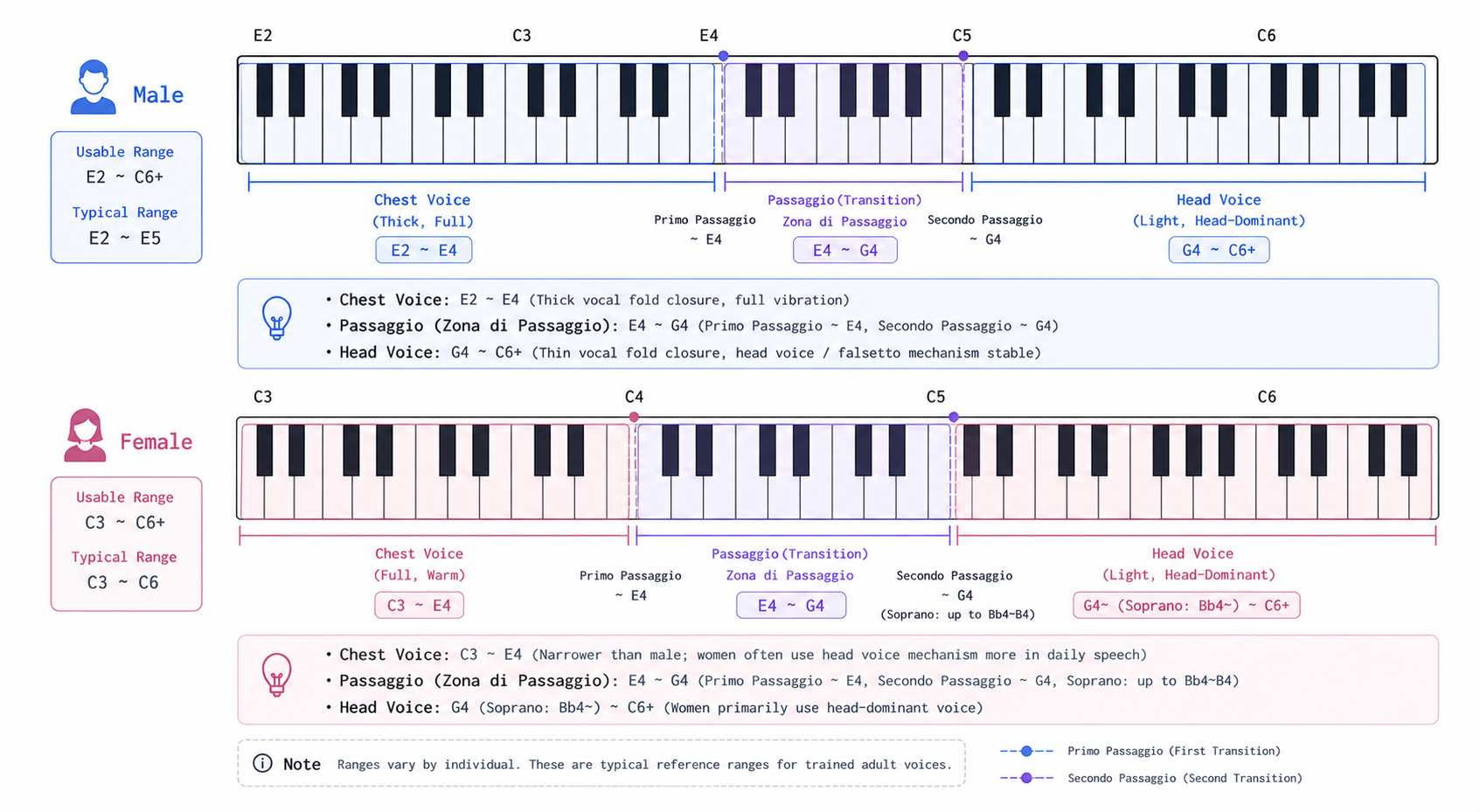
The passaggio is where your voice naturally needs to shift registers. Forcing chest voice past this zone instead of making the transition is one of the most common causes of flat high notes.
3. Your ear training hasn't caught up yet
If you don't have a clear, reliable mental image of what a target pitch sounds like before you sing it, you're essentially aiming at something you can't fully see. You might get close — it might even feel right — but there's a constant drift happening just below the surface. Pitch problems aren't purely a technique issue; they're often an ear training issue.
This shows up most clearly on intervallic jumps — when you need to land a note a third, a fifth, or an octave above or below where you just were. If your ear hasn't thoroughly internalized how far that interval actually travels, you'll consistently undershoot it. A lot of singers do scale drills regularly but still go flat in actual songs — and the missing piece is usually interval recognition, not scales.
How to Fix It — In Order
Start by figuring out where it's happening
Before you start correcting anything, it's worth getting a clear picture of the pattern. Open Vocal Pitch Monitor in your browser, allow microphone access, and sing through whatever you've been working on. Your pitch shows up as a real-time line graph — pitch names on the vertical axis, time moving left to right.
Things to look for:
- Does the line drift downward over the course of a held note?
- Does the flatness only appear approaching a high note, and not elsewhere? (passaggio issue)
- Does the line dip specifically toward the end of phrases, when you're running low on breath?
The pattern tells you which problem to focus on first.
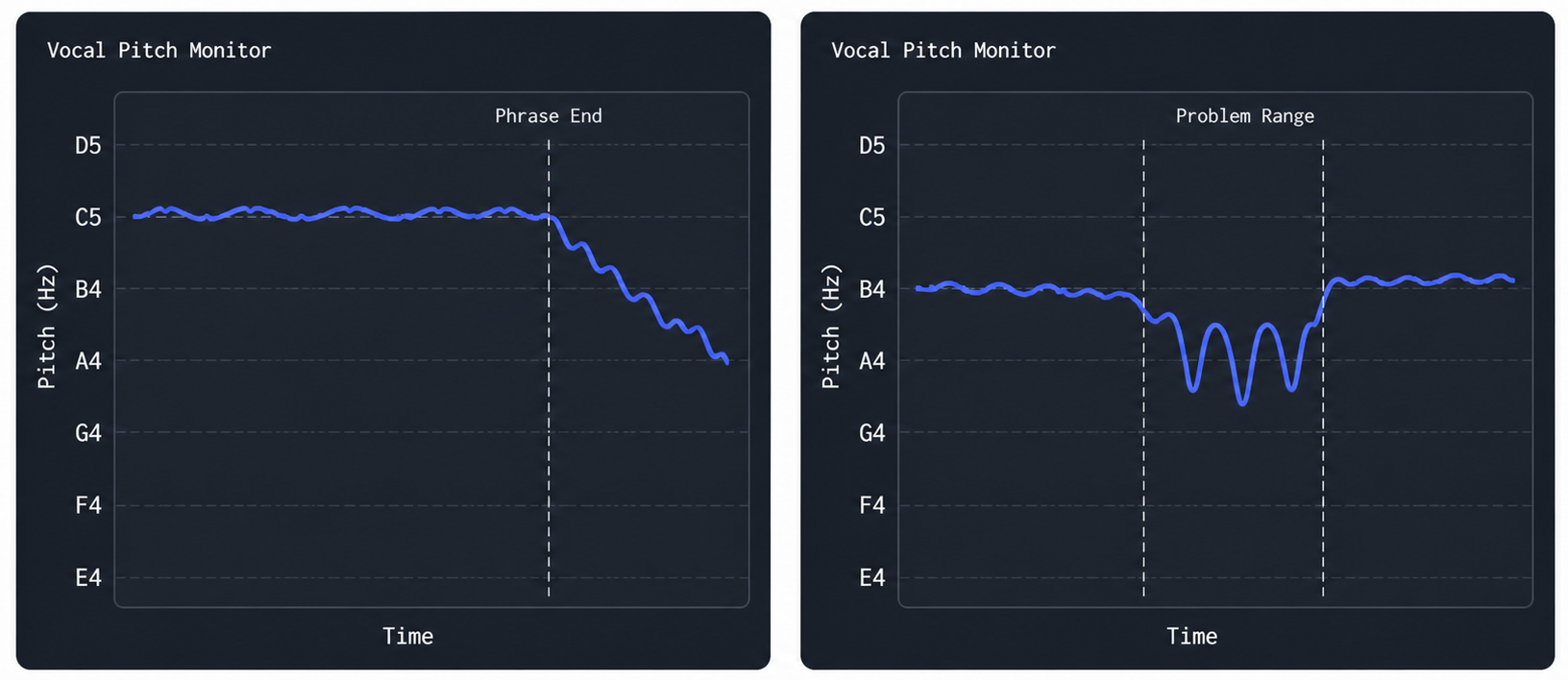
Left: pitch dropping toward the end of phrases. Right: flatness that's concentrated in one specific part of the range and stays consistent elsewhere.
Fixing breath support
Before you start a phrase, check that your core is actually engaged. Put a hand on your belly, make a long "shh" sound, and notice whether your abdominal muscles are pushing outward steadily the whole time — or whether there's a moment where everything caves in or the ribcage suddenly drops. That collapse is usually exactly when the pitch falls.
A practical drill: set a slow tempo in Online Metronome — somewhere around 70–75 BPM — and hold a single "ah" vowel for four beats. Watch the Vocal Pitch Monitor graph while you do it. The goal is a flat horizontal line, not one that sags by beat three. Once that feels stable, gradually work the tempo up.
Working through the passaggio
The principle here is transition early. Don't wait until you've already arrived at the break point to start shifting registers — start lightening up and moving toward head voice two or three notes before you get there. That smooths out the crossover instead of forcing a sudden gear change.
One approach: find the notes around your passaggio using Virtual Piano, then hum through the range from one note below to one note above on a "hmm" sound, slowly. Keep Vocal Pitch Monitor open and watch whether the graph stays smooth through that transition or hits a sudden dip. The sound will naturally get a little thinner as you cross into head voice — that's correct, that's what's supposed to happen.
Vocal Scales is useful for this too. Pick a scale that runs through your passaggio zone and run it with the pitch monitor going. Note which specific pitch causes the line to drop, and then focus your practice on starting the register transition one note earlier than that.
Ear training with a drone
A drone is just sustaining a single reference pitch and matching it. Click a note like A4 in Virtual Piano, then sing the same pitch on "ah" while the piano tone is still ringing. Watch the Vocal Pitch Monitor graph and see whether your line is sitting at the same height as the reference. Repeat until you can reliably land on it without any drift. Over time, this trains your ear to hold a much more precise internal reference.
For interval work, take that same starting note and practice jumping to a fifth above it — say, C4 to G4. Every time you land on the G4, check the graph. If your arrival note consistently lands slightly below the target and then creeps up to it, that's your ear undershooting the distance. The goal is a clean landing right on the pitch, not an approach from below.
Common Mistakes to Avoid
Going straight for the hard stuff without warming up. If you start hammering away at passaggio-range notes before your voice is properly warm, you can actually reinforce the flat pattern rather than correct it. A 5–7 minute warmup — humming, then lip trills, then easy scales in a comfortable range — makes a noticeable difference in how stable the graph looks from the start.
Running the whole song over and over. If there's a specific section that keeps going flat, looping the full song isn't the most efficient fix. Isolate the two notes before the problem spot and the two notes after it, and drill that small chunk repeatedly. The pitch monitor will show you exactly where the line breaks.
Pushing through when you're tired. Once your vocal cords fatigue, their vibration characteristics change — and you'll see sections that were previously stable on the graph start to wobble. That's the signal to stop, not push harder. Short, focused practice sessions are consistently more effective for intonation work than long, exhausting ones.
Using MusicalBoard's Vocal Pitch Monitor
Vocal Pitch Monitor gives you a visual anchor for all of this — no installation, just open it in your browser and allow the microphone.
A simple session structure that works well:
- Play a reference pitch in Virtual Piano and hum it back with the monitor running. That's your warmup.
- Run a scale in Vocal Scales and watch for where the line dips. That's your diagnostic.
- Use Virtual Piano drones to work through narrow interval ranges in the problem area. That's the targeted fix.
- Record a short phrase with Singing Recorder and play it back. The difference between what you heard live and what the recording sounds like is, itself, ear training.
The pitch monitor stays active during recording, so you're getting both live visual feedback and the playback comparison at the same time.
Fixing flatness isn't really a talent issue. It's about figuring out where and why your pitch is dropping — using a graph instead of just your ears — and drilling that specific thing until it sticks. Once you can actually see it, the improvement tends to happen faster than you'd expect.