
Surprisingly few singers actually know where their voice starts and where it tops out. There's a real difference between vaguely feeling like you're "somewhere in the middle" and knowing that C3 to A4 is your comfortable range. In this post, I'll walk through how to find your vocal range step by step — how to read the results and how to connect them to your practice. I'll also be using the Vocal Range Test on MusicalBoard, which runs right in your browser.
Why Your Vocal Range Actually Matters — "Feel" vs. "Data"
One of the most common mistakes when starting to learn singing is just copying the original key of whatever song you love. If that key happens to suit your voice, great. If it doesn't, you end up either forcing and straining for notes that are too high, or sounding weak and unsupported because they're too low. Do that long enough and you'll tire out your voice — and make practice feel like a chore.
Here's what changes when you know your range:
- You can choose songs or transpose keys so your voice sits where it sounds most natural.
- You can identify where your passaggio (the break between chest voice and head voice) falls, and target that area in practice.
- You get a rough sense of your voice type — soprano, tenor, baritone, and so on — which helps you find repertoire that actually fits you.
Your range is partly innate, but it does expand with consistent work. Mapping it now also gives you a clear before/after to compare against months down the line.
A Few Things Worth Knowing Before You Test
Your voice isn't the same every day
Your voice is surprisingly sensitive to how your body is doing. When you're tired, slightly hoarse, or fighting off a cold, your upper range shrinks. On a well-rested, healthy day it can feel freer than usual. That means any single test is really just a snapshot of your voice today. Don't treat one result as a fixed ceiling — run the test on a few different days to get a sense of the pattern.
Don't count the notes you have to force
The most common mistake is counting every last squeezed-out note as part of your range. If you need to choke it out, if it sounds like a cough, if your throat is gripping hard just to make the sound happen — that note isn't part of your usable range. The standard is simple: can you sustain it naturally? If it cracks or collapses the moment you try to hold it, that note is still outside your stable range.
Warm up first — even just five minutes
You wouldn't rev a cold engine to full throttle, and the same logic applies to your voice. Before testing, spend five minutes on lip trills, easy humming on "mm~", and a couple of light scales in your lower range. That's really all it takes to get things moving. Skipping warmup and diving straight into high notes will make your range look narrower than it actually is.
Finding Your Vocal Range — Step by Step
Step 1: Find a reference pitch
If you have a piano or keyboard nearby, start on middle C (C4). No instrument? Open Virtual Piano and click the C4 key to hear the pitch. Once you have it, sing "ah~" or "mm~" along with it. Don't try to force yourself onto the note — just listen and let your voice follow naturally.
Step 2: Find your lower limit
From C4, step down one semitone at a time: B3 → A3 → G3 → F3, and so on. Hold an "ah~" on each note. Keep going until the sound stops coming out naturally. The note just above where things fall apart is your current lower boundary.
As you descend, watch for warning signs: the tone getting rough or crackly, a lot of air leaking through, or the sound cutting out entirely. Those are all signs you're approaching your limit.
Step 3: Find your upper limit
Come back to C4 and head up: D4 → E4 → F4... Hold "ee~" or "ah~" on each step. As you climb, you may naturally shift into falsetto or head voice — include that range in the test. Your upper limit is wherever the sound simply stops being producible.
The same rule applies here: if you're forcing it, it doesn't count.
Step 4: Write it down
Your lowest stable note and your highest stable note together define your current vocal range. If you can go from E2 to C5, that's your range. Within that range, there's a narrower zone — your tessitura — where your voice is most comfortable and resonant. That's typically a few notes in from both edges, and it's the range you'll actually rely on most in performance.
Voice Types — Soprano to Bass
Once you have your range, you can get a rough sense of your voice type. The categories below come from classical voice training. Keep in mind that voice type isn't determined by range alone — weight, timbre, and the position of your passaggio all play a role, so use this as a starting point, not a verdict.
| Voice Type | Approximate Range | Voice |
|---|---|---|
| Soprano | C4 – C6 | Female |
| Mezzo-Soprano | A3 – A5 | Female |
| Alto (Contralto) | F3 – F5 | Female |
| Tenor | C3 – C5 | Male |
| Baritone | A2 – A4 | Male |
| Bass | E2 – E4 | Male |
A typical soprano range runs from C4 (middle C) up to C6 (high C). Tenors cover C3 to C5, though some can reach F5. Baritones generally sit between A2 and A4 — it's the most common male voice type. All of these categories overlap at the edges, and plenty of people fall right between two of them.
In pop or rock, these classifications aren't applied nearly as strictly as in classical settings. For most practical purposes, a more useful question is simply: what key makes my voice feel most at home?
Using the MusicalBoard Vocal Range Test
Beyond the manual piano method, the Vocal Range Test gives you a lot more to work with — and it runs straight in your browser.
What sets it apart from a basic pitch detector is that it shows you accuracy note by note, in color. As you sing through a range divided into semitone columns, each note fills in with color based on how consistently you're hitting the pitch:
- Green tones: pitch was stable and on target for that note
- Yellow to orange: slightly off, but in the ballpark
- Red tones: significant pitch deviation — these are the notes that need work
Up in the top right, you'll see four readouts: SCORE (your average accuracy for the whole session), LIVE (your real-time score for the note you're currently singing), RANGE (the span of pitches detected this session), and VOICE (a voice type suggestion based on that range).
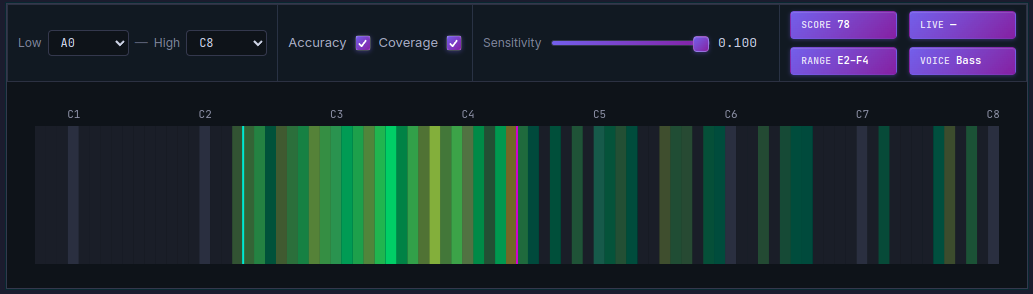
It's not just your top and bottom notes — you can see exactly which pitches you're landing and which ones still need attention.
How to actually use it
- Allow microphone access, then slowly sing "ah~" through your range from bottom to top, holding each note for 2–3 seconds. Rushing through won't give the heatmap enough data to fill in properly.
- Go from your lower limit up to your upper limit, then back down.
- The filled columns show where you produced sound. The green areas are your current stable range.
- Red zones are your practice targets. Work on those notes in your next session, then re-run the test — the color change over time is genuinely motivating.
If you want an even more detailed view, open Vocal Pitch Monitor alongside it. The real-time pitch graph shows exactly how much your pitch line wobbles on each note. The heatmap alone is plenty to start with, but the pitch monitor is useful when you want to understand why a particular note is giving you trouble.
Turning Your Results Into Practice
Start with what already works
The zone with the deepest, most consistent green in your heatmap is your current tessitura — where your voice is most naturally at home. Use that as your anchor when picking songs or keys. If a song you love sits a third too high or too low in its original key, try transposing by two or three semitones and see how it feels.
Make the red zones your next goal
Red sections aren't "bad notes" — they're not-yet-stable notes. Open Vocal Scales and run scales centered on those pitches while watching the pitch monitor. You'll start to see what pattern your voice uses when it misses — flat, sharp, or just unstable — and drilling just that one note can clean it up surprisingly fast.
Check in regularly
Running the test every two to three weeks and comparing results is one of the clearest ways to track real progress. Notes that were red become yellow, then eventually green. Your SCORE going up means your overall pitch accuracy is improving across the board. Seeing that shift visually makes a bigger difference to practice motivation than you might expect.
Log data from your off days too
Comparing a result from a well-rested day against one from a tired or slightly hoarse day shows you your voice's actual variability. Some days the top of your range opens up; other days the lower register feels richer. Once you know that pattern, it's much easier to adjust your practice accordingly — on a rough voice day, skip the high-note drills and spend that time on legato work in your comfortable middle range instead.
Common Questions
Q. Does falsetto count toward my range?
For practice purposes, yes — include it. It's worth keeping two numbers: your practical range (what you can use comfortably in a song) and your full range including falsetto. If you're using your range for an audition or part assignment in a choral setting, the convention is to present your chest voice range only.
Q. Can I actually expand my range?
Gradually, yes. Consistent practice tends to improve stability at both edges of your range rather than dramatically extending it. The structural limits set by your instrument won't change radically, though. Honestly, getting every note within your current range working well is faster and more rewarding progress than chasing the outer extremes.
Q. My range seems to fall between two voice types. What do I do?
That's more common than people realize. When you're on the boundary, range alone isn't enough to categorize you — you'd also look at where your passaggio sits, how heavy or light your tone is, and which register feels most natural to sustain. If you're working with a voice teacher, it's worth bringing it up. They'll give you a more accurate read than any chart can.
Wrapping Up
Finding your vocal range is a starting point, not a destination. You need to know where you are before you can figure out where you're going. Before you spend another practice session forcing notes that aren't there yet, take ten minutes to find out where your voice actually lives right now. Get comfortable and consistent in that zone first. Then, gradually, work outward — that's the safest and fastest path to real growth.
References: