
Vibrato is what happens when you hold a note and your pitch oscillates slightly up and down in a regular, repeating pattern. When that wave is smooth and even, it adds warmth and richness to your voice — the note feels alive. When it's too slow or too fast, though, it can come across as wobbly or tense instead. This post covers how vibrato is physically produced, what to aim for when you practice, and how to use a real-time pitch graph like Vocal Pitch Monitor to look at your own vibrato objectively.
Vibrato Isn't Something You Do — It's Something That Happens
The most common trap for anyone trying to learn vibrato is trying to produce it by physically shaking the jaw or throat. That's not how it works.
The longstanding view in voice science research is that vibrato is a neuromuscular oscillation — it happens naturally when the muscles around the larynx are in a balanced state of tension. The cricothyroid muscle, which lengthens and tensions the vocal folds, contracts and releases in a regular cycle that makes pitch rise and fall (Vibrato: Pitch Oscillation in the Singing Voice — voicescience.org). It's less an intentional action and more an automatic response your body produces when breath support is stable, glottal contact is appropriate, and there's no excess tension in the pharynx or tongue.
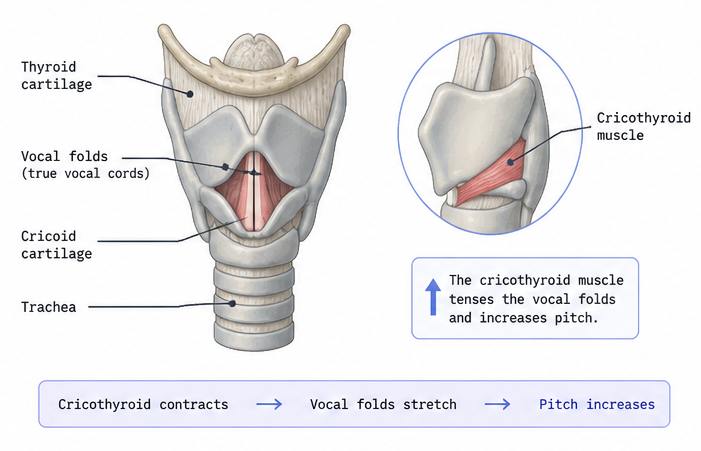
Vibrato emerges from the balanced interaction of the muscles surrounding the vocal folds.
So what if your vibrato hasn't shown up yet, or it's inconsistent? The answer isn't to practice vibrato itself first. It's to create the conditions where vibrato can actually occur.
The Two Components of Vibrato
When researchers measure vibrato, they're mainly looking at two things.
Rate: How many times per second the pitch cycles up and down, measured in Hz. For trained classical singers, the typical range is 4.5–6.5 cycles per second (voicescience.org — Vibrato Rate). Below about 4 per second sounds wobbly; above 7 can sound strained or pinched. In pop, musical theatre, and CCM, slightly faster rates are generally accepted as natural.
Extent: How far the pitch deviates from the target note. In classical singing, oscillation within roughly half a semitone (about 50–120 cents) is typical (voicescience.org — Vibrato Extent). Too wide and the pitch sounds unstable; too narrow and it barely registers as vibrato at all.
When both of these stay consistent and even across a phrase, vibrato gets described as "good." If the rate or extent shifts noticeably from note to note or phrase to phrase — even if the numbers are technically in range — it ends up sounding unsteady.
Three Common Problem Patterns
No Vibrato at All
This is the most common situation for beginners. If there's excess tension in the throat or the muscles around the larynx, the natural oscillation can't happen. Usually the cause falls into one of three categories.
First, insufficient breath support — when airflow isn't coming up from below in a steady stream, the vocal folds can't maintain the right kind of tension. Second, jaw or tongue tension — gripping the jaw or pulling the tongue root back are habits that can quietly block the muscles from responding freely. Third, dragging chest voice too high — if you're forcing chest register past the passaggio, the folds are too compressed for vibrato to emerge.
Vibrato That's Too Slow or Irregular (Wobble)
Usually called a "wobble." This is a slow, wide oscillation below about 4 cycles per second (voicescience.org — Vibrato Rate). It can show up when glottal contact is too loose, when chest voice is being carried too high, or when there's too much air pressure (SingWise — Vibrato: What It Is and How to Develop It). You'll also notice wobble appearing toward the end of a long performance when the voice starts to fatigue.
Vibrato That's Too Fast (Bleat)
On the other end, oscillation above 7 cycles per second tends to sound tense or constricted (voicescience.org — Vibrato Rate). This usually indicates excess tension in the larynx or pharynx. Some genres use a narrow, fast vibrato intentionally as a stylistic choice — but if it's showing up when you don't want it, tension release should come before anything else.
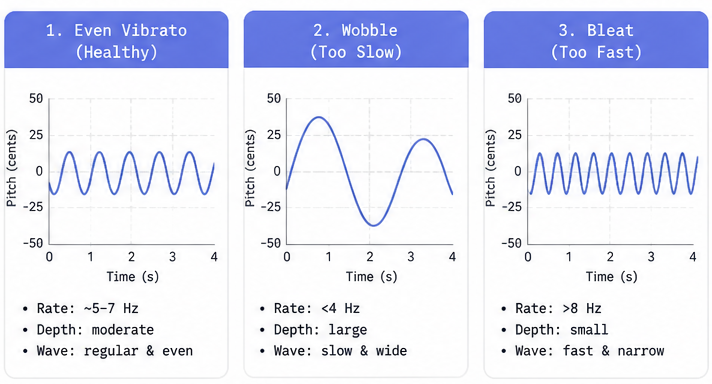
Looking at the spacing and width of the wave on a pitch graph lets you see your vibrato's current state directly.
A Step-by-Step Approach to Developing Vibrato
Step 1 — Create the Conditions for Vibrato to Occur
Before doing any vibrato-specific work, get your body into a state where vibrato is physically possible.
Lip trills: Bring your lips loosely together and let air flow through so they flutter. Once that's easy, try sustaining a pitch while you do it. The idea is to feel what it's like to produce a note without gripping the throat. If you run a pitch graph while trilling a single note for 4–5 seconds, you might catch a very faint wave starting to form — that's the beginning of it.
Sustained "ng" hum: Lift the sound toward the nasal resonator with an "ng" hum and hold a pitch for 5 seconds or more, without deliberately moving the larynx or squeezing the throat. The goal here isn't to produce vibrato — it's to practice maintaining a note with no forced tension involved.
One thing that helps: pull up Virtual Piano, pick a note in the middle of your range, and let it ring as a drone while you hum along. Having a reference pitch makes it easier to stay centered without drifting, so you can hold longer without second-guessing your intonation.
Step 2 — Use a Pitch Graph to See Where You Are
It's hard to work on something you can't actually observe. Open Vocal Pitch Monitor in a browser, allow microphone access, and watch the real-time graph while you sustain notes. A few things to look for:
- Does the line land on the target pitch immediately when you start the note, or does it slide up from below?
- While you're holding the note, does the line trace a regular wave, stay flat, or move irregularly?
- Is the wave spacing consistent, or does the rate shift partway through a phrase?
- Is the wave too narrow to see clearly, or wide enough that the pitch looks unstable?
If you don't have vibrato yet, you'll mostly see a flat line on long notes. That's not a problem — knowing what your baseline looks like is the whole point of this step.
Step 3 — Approach It Through Release, Not Shaking
Deliberately shaking your jaw or throat to produce a wave can look like vibrato on a graph in the short term, but it tends to cement bad habits. A more useful approach is to identify where you're holding tension and work on releasing it piece by piece.
Slow portamento: Slide from C4 up to G4 and back down, slowly and continuously, in a loop. If your jaw or throat is stiff, this motion can help loosen things up. Turning on Online Metronome at around 60 BPM and matching each slide to the beat helps you keep the movement steady rather than rushing.
Even breath support: Sustain a note on an "ah" vowel and focus on keeping your abdominal support consistent until the end of the breath — not pulling inward suddenly, not ramping up pressure, just a steady resistance through the whole phrase. When this sensation becomes familiar, the rate and extent of vibrato tend to stabilize on their own.
Step 4 — Apply Vibrato Within Scales
Once vibrato is starting to appear naturally during exercises, the next step is keeping it through scale movement. Open Vocal Scales, choose a key that sits in the middle of your range, and hold each note long enough to let vibrato settle in before moving on. Start slow — if the tempo is too fast, you don't have time for vibrato to emerge at all.
Keeping the pitch graph running shows you exactly which notes carry vibrato and which ones drop it. Typically, vibrato disappears as you go higher — which is a sign that tension is increasing at that part of your range. Note those spots and come back to them for focused work.
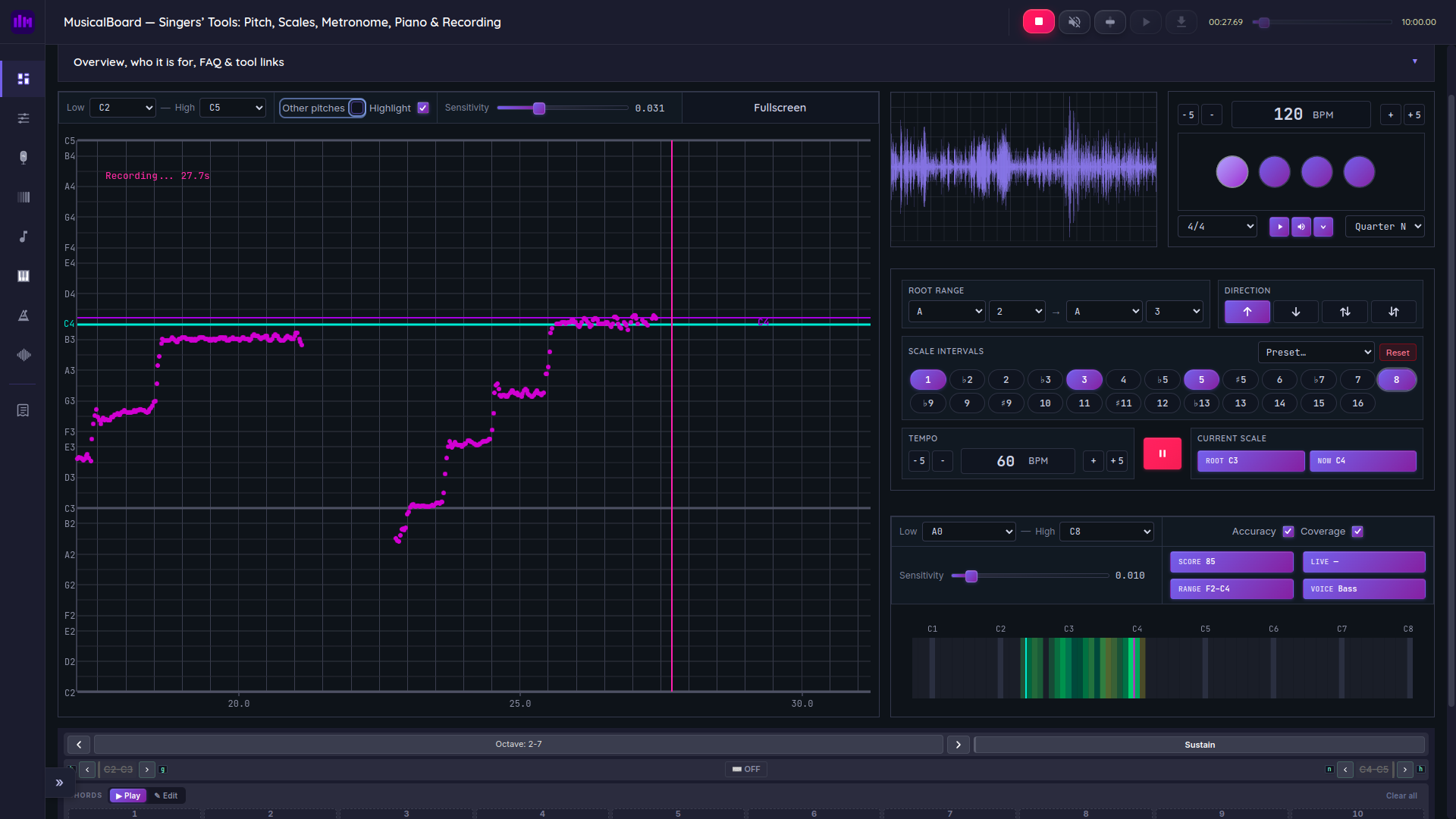
Running scale accompaniment alongside the pitch graph makes it easy to see at a glance where vibrato appears and where it disappears.
Step 5 — Train Your Ear With Recordings
Recording yourself is more important than most people realize. What you hear while singing — filtered through bone conduction — sounds lower and richer than what the microphone actually captures. The same is true for vibrato: it can feel very present in the moment and then be nearly inaudible on playback.
Record a short phrase with Singing Recorder and play it back right away. Vocal Pitch Monitor stays active during recording, so you can re-examine the graph while the audio plays back and see where the wave shows up and where it stalls. Comparing what you heard in the moment with what the graph shows — and doing that repeatedly — is how your internal sense of what vibrato actually sounds like gets calibrated. After a few sessions you start hearing the difference before you even look at the graph.
Vibrato Looks Different Depending on the Genre
There isn't one universal standard for how vibrato should sound or when it should be used. That depends heavily on the style.
Classical / Opera: Vibrato is sustained throughout phrases, not just on final notes. Extent is relatively wide, and the typical rate of 4.5–6.5 cycles per second is the norm.
Pop / R&B: Phrases often start straight and arrive at vibrato on the final note of a line, using it as an expressive punctuation rather than a continuous texture.
Legit Musical Theatre: Similar to classical in that vibrato is used throughout, but with more deliberate variation — widening it at dramatic peaks, pulling it back during quiet, lyrical moments.
CCM / Gospel: Frequent shifts between vibrato and straight tone, sometimes within the same phrase. Fast, narrow vibrato is sometimes used as a signature stylistic choice in this genre.
Knowing which tradition you're working in gives you an actual target to aim for — otherwise "practice vibrato" is too vague to be useful.
Putting Vocal Pitch Monitor to Work
Vocal Pitch Monitor is particularly well-suited to vibrato work because it lets you watch the wave form while it's happening. Things that are easy to miss by ear alone — the vibrato cutting out halfway through a held note, the rate speeding up in the second half of a phrase, a specific vowel where it disappears entirely — show up clearly on the graph.
Here's a short session structure that works:
- Warm up with a drone from Virtual Piano, humming along and checking the graph for any hint of a wave
- Run Vocal Scales slowly through your range and watch where vibrato appears and where it doesn't
- Pick a note where vibrato is absent and work on it specifically over the drone
- Record a short phrase with Singing Recorder, play it back, and compare what you hear against the graph
- In your next session, record the same phrase again and compare the two side by side
You won't notice dramatic changes day to day. But if you record the same phrase every few sessions, you'll start to see the wave settle into a more regular pattern over time. That's the whole thing, really — watching that change happen is what keeps the practice going.
Once you understand that vibrato can't be forced, the direction of practice shifts entirely. Less tension, more stable breath, and consistent observation of your own graph. That's genuinely enough.