
There are days when you sing the same chorus three times and are left only wondering, “Was that a little better?” On those days, it helps more to switch briefly between two recordings made under matching conditions than to keep singing. Takes A–D in Singing Recorder lets you keep and select up to four vocal takes in one browser for comparison. This article uses vocal take A/B comparison not as a pass-or-fail test, but as practice for finding one thing to change in the next attempt.
When you first listen back, the flaws usually sound loudest: a wavering note, a breath sound, or a tone thinner than you expected. It can make you think, “Should I start again from the beginning?” Yet a single recording also contains the effects of your condition that day, microphone position, and the sound you made just before it. A useful comparison does not end with “B is better.” It is closer to putting one difference between A and B into words, then checking the action that created that difference in the next take.
Why keep several takes? Use sound, not memory, as the reference
The voice you hear while singing is not the same as the voice on a recording. While you sing, internal vibration, the accompaniment, and concentration on the next lyric all play a part. During playback, only the sound that entered the microphone and its timing remain. You may feel that a high note opened well in the moment, then hear a narrowed vowel or a first consonant that arrives late when you listen back.
That difference is not a strange sign of poor ability. It is one reason to save recordings. If you try to judge pitch, rhythm, diction, breathing, and volume at once, it is hard to hear any of them properly. Separating takes lets you separate your listening targets too.
- Take A: a baseline recording that reveals your current habit
- Take B: a recording with one deliberate change
- Take C: a recording that checks whether B's change was more than luck
- Take D: a final take worth keeping after practice
You do not need to fill all four slots. A and B are usually enough. Do not discard A too quickly, though. To judge whether B improved, you need the actual sound of the same phrase, not the version of A in your memory.
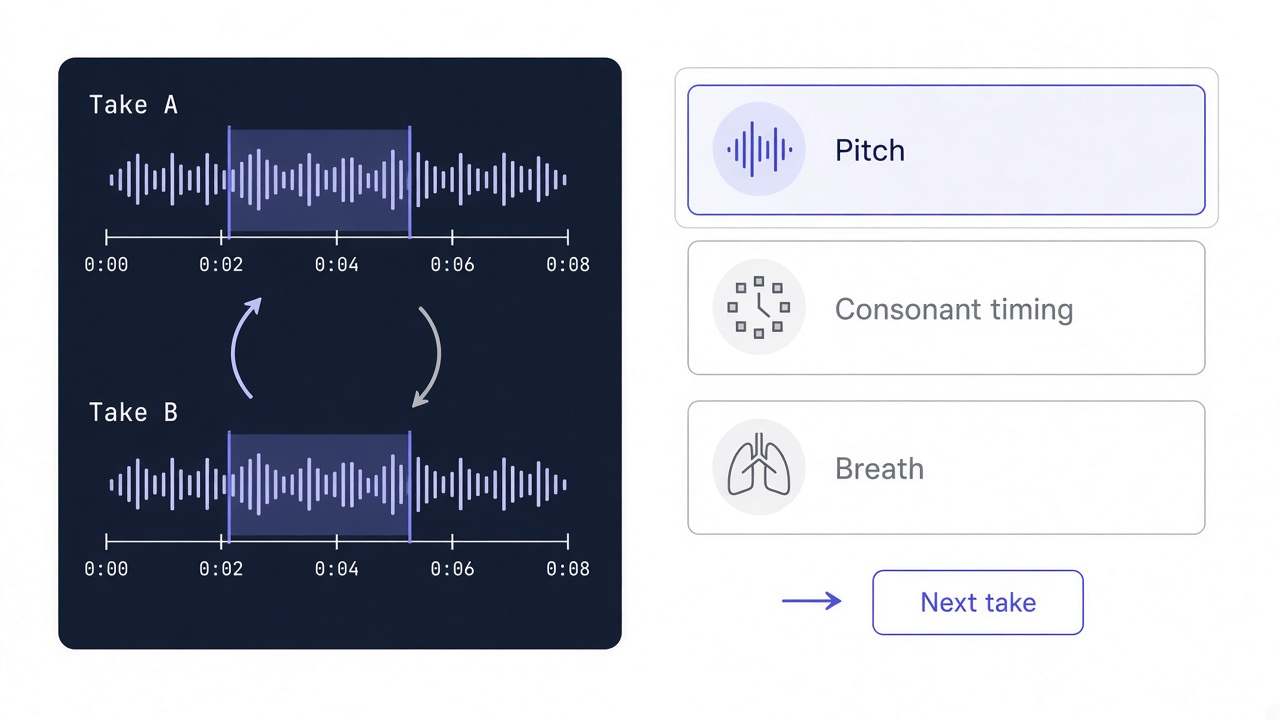
Choosing one thing to hear at a time turns take comparison from a vague impression into the next action.
Comparable takes need similar conditions first
When two recordings differ, comparison becomes unclear if you cannot tell whether the cause was a vocal change or a changed condition. At home, it is common for the accompaniment to be quieter in the first take and louder in the second, or for one take to be made 10 cm from the microphone and the next much closer. Those differences can change the sound substantially.
At first, keep just these four things fixed.
- Choose the same phrase. One or two lines, or roughly 8–16 bars, is enough. With an entire song, it becomes unclear what you are comparing.
- Match the starting point. If you use accompaniment, start from the same point one or two bars before the first lyric. Do not change the BPM or first beat when using Online Metronome as well.
- Do not change microphone or backing volume. If you need to adjust the equipment between takes, note that fact and leave tone or volume out of the comparison.
- Change only one action at a time. Make it specific, such as “take the breath earlier.” If you try to fix high notes, diction, and rhythm at once, it is hard to know why B changed.
For example, suppose you repeatedly enter late on the first line of a 92 BPM ballad chorus. Listening to Take A, write: “The first consonant lands behind the drum.” In Take B, prepare the breath just before the lyric and mentally prepare the consonant one beat ahead of beat one. What you compare here is not the brightness of the high note or the final vibrato, but where the first consonant lands. If B improves, use the same breath preparation in Take C. If it works similarly the third time, you have a usable method rather than a one-off lucky result.
How to open Takes A–D in Singing Recorder
After making a short recording in Singing Recorder, open Takes and backing in the Controller strip to see saved takes as A, B, C, and D. Each button also displays its duration, and selecting a letter makes that take the current one. Move the playback gauge to the problem area, then select another take and listen at the same point.
For a first session, this is the simplest order.
- Record the same phrase as Take A.
- Put the playback gauge 1–2 seconds before the phrase that feels problematic.
- Listen to A and write one sentence. For example: “The
yconsonant inyouarrives behind the beat.” - Choose one action to change, then record the same phrase as Take B.
- Alternate between the same point in A and B.
- If you hear a difference, repeat the same action in C. If you do not, make the action smaller and more specific.
You do not need to listen from beginning to end every time you select a take. If the problem section is 15 seconds, moving only through those 15 seconds is enough. Long playback tires the ear, and later you start filling in differences with memory. A short switch from two bars in A straight to the same two bars in B is more accurate.
What should you hear? One question per playback
“Better” is too broad to move practice forward. Narrowing the listening question like the examples below turns the comparison result into an action.
Pitch: not only whether it was right, but where it moved
In Take A, first listen for whether the end of a sustained note falls, whether the voice slides up from below just before reaching the note, or whether it presses only on high notes. In B, open the vowel sooner or check the target note once on a piano before singing the same phrase. Virtual Piano is useful for finding the reference note, and Vocal Pitch Monitor can help you see the pitch movement alongside what you hear.
The important caution is that a graph is not a scorecard. A smoother pitch line does not automatically improve the rhythm or feeling of the words. It works better as supporting evidence for a change you heard, such as “the end of the second note fell less than before.”
Rhythm: listen to the first consonant, not the long vowel
If the rhythm feels late, listen to the first consonant rather than the long vowel. A word that begins with a vowel can have a blurry start, but consonants make their relationship to the beat easier to compare. If the first consonant consistently trails in A, prepare the breath one beat earlier in B, or mentally say the consonant just ahead of the accompaniment.
The consonant may be in time while the singing still sounds rushed. In that case, compare the moment you move to the next note. Check that you did not bring every note forward while trying to place the first consonant. Online Metronome is useful for finding the beat again, but when the song has real accompaniment, the final comparison should happen over that same accompaniment.
Breathing and sound: comparison does not require singing louder
Comparing two takes does not mean you need to make a louder sound. On a tired day, it is safer to hear whether the throat rushes from the breath to the first note than to push a high note by increasing volume. Write down the fact you heard, such as “the first note after the breath is less rough in B,” rather than “B is louder.”
The U.S. National Institute on Deafness and Other Communication Disorders (NIDCD) advises avoiding singing when the voice is hoarse or tired, drinking water, taking vocal rest, and using breath support so that effort is not concentrated in the throat. Taking Care of Your Voice — NIDCD is a public-health resource that includes this guidance. If recordings repeatedly sound hoarse, high notes suddenly disappear, or you feel pain, rest instead of filling more take slots and, when appropriate, consult an ear, nose, and throat specialist or voice professional.
When it is not working: reduce the comparison rule, not add more takes
If you still cannot hear a difference after four takes, your listening criteria are usually too numerous, or the conditions between A and B were too different. Start smaller again with the following approaches.
Add a time and place instead of saying “A is bad.” Write something like, “The note slides down on I in the second chorus line,” or “The first consonant after the breath at the end of verse one is late.” This gives the next recording a section to check.
Sing B as an experiment, not an improved version. The pressure for B to be better makes it easy to overwork the voice or change every element. B is one experiment: “What happens if I prepare the breath one beat earlier?” Even if the result is not good, you have ruled out one method, so it is not a failure.
Use C and D after a rest. If your throat feels stiff or your ears feel dull after singing A and B in succession, drink water and rest quietly for 2–3 minutes. Recording C afterward makes it easier to separate fatigue from repetition from real improvement. If the answer does not come that day, leaving D empty and listening to A and B again the next day is also a good choice.
Write down why the better take worked too. Do not stop at “B is better.” Write something like, “Preparing the breath before the first note placed the consonant on the beat.” What you can reproduce in the next session is an action, not a result.
A 12-minute practice example: finish an A/B comparison with one line
On a day without much time, choose one line of a chorus and finish in 12 minutes.
0–2 minutes — Set a baseline: Choose one line to sing and one problem. For example: “The breath becomes rushed before the high note.” If you do not know the reference note, check only the first note in Virtual Piano.
2–4 minutes — Take A: Sing as you normally would. When you finish, move the gauge to the problem area, listen once, and write a short note such as “the first note after the breath sounds pressed.”
4–6 minutes — Practise one action: Without singing the lyric, take a breath and make only the first note two or three times. Change one thing, such as preparing the breath slightly earlier instead of using more force.
6–8 minutes — Take B: Record again with the same backing, phrase, and microphone position. Alternate between A and B only at the problem area.
8–10 minutes — Take C: If B improved something, sing once more using the same method. If nothing changed, slow it down or halve the phrase before trying again.
10–12 minutes — Note the next practice: Choose the take from A–C that best met the purpose, then leave one line such as “next time, breathe before beat one.” This is not time for choosing the most polished take; it is time to choose the next starting point.
Practise take comparison with MusicalBoard
Record a short phrase in Singing Recorder, then open Takes and backing to find the A–D buttons. Keep Take A as the baseline and choose the point to compare on the playback gauge. For Take B, change only one of pitch, consonant timing, or breathing, then record the same phrase. After alternating briefly between the two takes, return to Vocal Pitch Monitor if pitch is the problem, or to Online Metronome or the backing if the beat is the problem, and check just one more action.
Take comparison is not time to judge your voice. Rather than trying to prove a large difference between yesterday and today, it is time to find a small connection, such as “this breath preparation changed the first note.” As those connections accumulate, it becomes much clearer what to try first when you sing the same phrase again.