At the very beginning of a piece of music, right next to the clef, two numbers are stacked like a fraction. Beginners often skip right over them. But these numbers determine the "rhythmic structure" of the music. 4/4 and 3/4 don't just differ in the number of beats — the entire feel and atmosphere is different. And 6/8 looks like it has 6 beats, but in practice it groups into two chunks. This post covers everything from what a time signature is to the very practical reasons why singers need to understand them, along with how to set and use time signatures in the MusicalBoard Online Metronome.
What Is a Time Signature?
A time signature is a symbol in music notation that tells you how many beats are in each measure and what type of note gets one beat. It's written as a fraction-like pair of numbers, where the top number (numerator) and bottom number (denominator) each carry different information.
- Numerator: The number of beats in one measure
- Denominator: The note value that equals one beat (4 = quarter note, 8 = eighth note)
So 4/4 means "four quarter notes per measure," 3/4 means "three quarter notes per measure," and 6/8 means "six eighth notes per measure."
How Time Signatures Create Feel
A time signature is not just mathematical notation. When the number and placement of beats changes, the rhythmic feel of the music changes entirely. The same melody sounds stable in 4/4 but swaying in 3/4. This is why composers choose time signatures with care.
4/4 Time — Music's Default Setting
4/4 is the most common time signature. It's also called "Common Time" and can be notated with a C symbol. There are four quarter notes per measure, and the stress pattern is strong-weak-medium strong-weak. The first beat is the strongest, and the third beat carries a moderate emphasis.
The vast majority of modern popular music — pop, rock, R&B, jazz, K-pop — uses 4/4. In a typical drum pattern, the kick falls on beats 1 and 3, and the snare falls on beats 2 and 4.
Examples of 4/4 Time
- Adele - Hello
- BTS - Dynamite
- Ed Sheeran - Shape of You
- Mozart - Piano Sonata No. 11, 1st movement
4/4 conveys a feeling of stability and regularity. That's why it's the most widely used time signature. Most of the music that naturally makes you want to tap your foot is in 4/4.
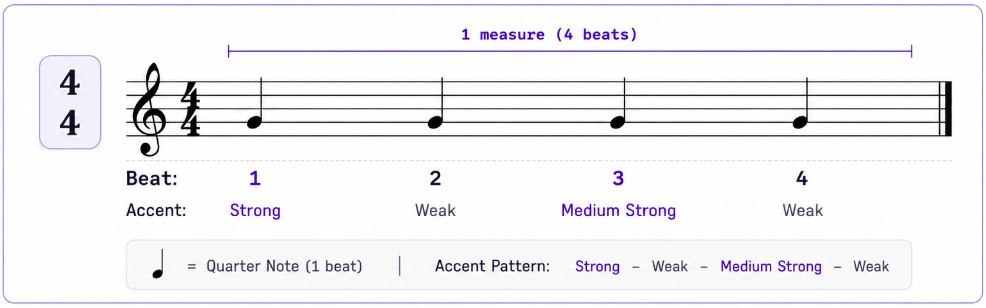
In 4/4 time, each measure contains four quarter notes and the first beat is the strongest.
3/4 Time — The Waltz Rhythm
3/4 has three quarter notes per measure. The stress pattern is strong-weak-weak. This repeating three-beat pattern creates a distinctive swaying feel. The genre that most famously capitalizes on this feel is the waltz.
In a waltz, the emphasis falls on beat one and the remaining two beats follow smoothly, giving the 1-2-3-1-2-3 rhythm a rotating, spinning quality. This is the rhythm of ballroom dance.
Examples of 3/4 Time
- Johann Strauss II - The Blue Danube
- Édith Piaf - La Vie en Rose
- Bob Dylan - Blowin' in the Wind (in certain phrases)
- Dvořák - Symphony No. 9 "New World," 3rd movement
3/4 is less common in modern pop, but it does appear in ballads and folk music. Music in 3/4 often carries a romantic or nostalgic quality.
2/4 Time — The March Rhythm
2/4 has two quarter notes per measure. Its strong-weak, strong-weak pattern is simple and driving. It's primarily used in military marches and fast polkas.
Examples of 2/4 Time
- Sousa - Stars and Stripes Forever
- Stravinsky - The Rite of Spring (certain sections)
- Many traditional folk songs and marches
2/4 has a fast, straight-ahead quality — it's the kind of rhythm that naturally syncs with footsteps. Think of gym class or a military march.
6/8 Time — Entering Compound Meter
This is where time signatures get more interesting. 6/8 has a 6 in the numerator, so it looks like "6 beats" — but in practice, you feel only 2 beats.
The Structure of 6/8
In 6/8, the six eighth notes are grouped into two groups of three. This creates a pattern of "one (strong)-two-three-one (medium strong)-two-three" within each measure. Because there are 2 felt beats, the practical pulse is closer to 2 beats per measure — but each of those beats is subdivided into three equal parts.
This type of meter is called compound meter. In simple meter, each beat divides into two; in compound meter, each beat divides into three.
The Difference Between 6/8 and 3/4
6/8 and 3/4 use the same number of notes (six eighth notes equals the same total duration as three quarter notes). But they feel completely different.
| Property | 3/4 | 6/8 |
|---|---|---|
| Felt beats per measure | 3 | 2 |
| Subdivision | Each beat divides into 2 | Each beat divides into 3 |
| Accent position | 1, 2, 3 → strong-weak-weak | 1, 4 → strong-weak-weak-medium strong-weak-weak |
| Feel | Waltz, even three-beat | Swaying two-beat, galloping feel |
The easiest way to tell them apart: 3/4 counts evenly as "one two three," while 6/8 feels like two groups of three — "one-and-a two-and-a" — flowing in two big pulses.
Examples of 6/8 Time
- Ludwig van Beethoven - Moonlight Sonata, 1st movement
- Traditional Irish jig music
- City pop — Mariya Takeuchi - Plastic Love (certain sections)
- Korean folk song — Arirang (in some slow versions)
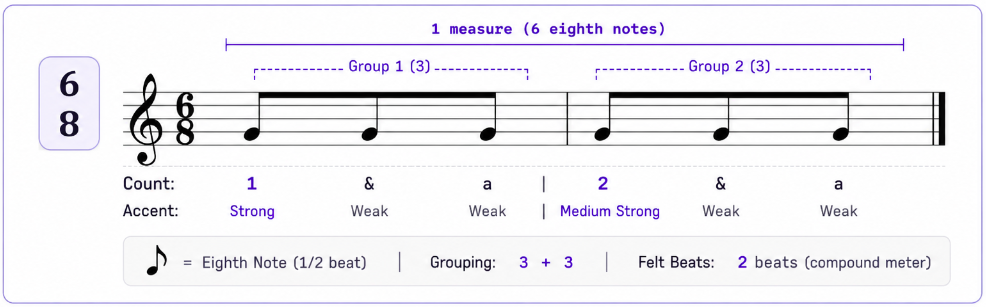
In 6/8 time, six eighth notes group into 3+3, forming two large beats. The note count is the same as 3/4, but the feel is entirely different.
9/8 Time — Three-Beat Compound Meter
9/8 has nine eighth notes per measure, grouped into three groups of three. This means there are 3 felt beats per measure, each subdivided into three — a compound triple meter. The stress pattern runs strong-weak-weak / medium strong 1-weak-weak / medium strong 2-weak-weak.
9/8 is less common than 6/8, but it appears in jazz, Celtic music, and progressive rock.
Examples of 9/8
- Peter Gabriel - Solsbury Hill (mixed with 4/4)
- Some flamenco styles
- Bill Withers - Lean on Me (in certain phrases, depending on the arrangement)
12/8 Time — Four-Beat Compound Meter
12/8 has twelve eighth notes per measure, grouped into four groups of three. The 4 felt beats make it feel similar to 4/4, but with a richer, rolling quality because each beat subdivides into three.
12/8 is commonly used in blues, slow rock, and music with a "shuffle" feel.
Examples of 12/8
- Stevie Wonder - I Was Made to Love Her style
- Many blues standards
- Sam Cooke - A Change Is Gonna Come
Simple vs. Compound Meter — Summary
| Type | Simple Meter | Compound Meter |
|---|---|---|
| Beat subdivision | Divides into 2 | Divides into 3 |
| Typical time signatures | 4/4, 3/4, 2/4 | 6/8, 9/8, 12/8 |
| Feel | Straight and direct | Swaying and fluid |
How BPM and Time Signature Differ
These two concepts are often confused. To put it plainly: BPM is speed; time signature is structure.
BPM tells you how many beats fall per minute. The time signature tells you how many beats are in each measure and what note value equals one beat.
The same 4/4 time signature at 60 BPM is slow; at 180 BPM it's fast. Conversely, the same 120 BPM in 4/4 and 3/4 produces completely different rhythmic structures.
One important detail: when setting BPM in 6/8, it matters what you're counting as one beat. When 6/8 is treated as a 2-beat compound meter, one beat equals a dotted quarter note. So BPM 60 in 6/8 means 60 dotted quarter notes per minute — which means 180 eighth notes per minute. Missing this distinction can make your metronome setting feel completely out of sync with the music.
Why Singers Need to Understand Time Signatures
Unlike instrumentalists, vocalists often practice without looking at sheet music. That means time signatures are easy to overlook. But understanding them has real, practical benefits.
1. Identifying the Downbeat Accurately
Knowing where the downbeat falls lets you place energy in the right place. The performance strategy for emphasizing beats 1 and 3 in 4/4 is fundamentally different from emphasizing only beat 1 in 3/4. Without understanding the time signature, you're left relying entirely on instinct, which makes it harder to sync with musicians or accompanists.
2. Setting the Metronome Correctly
Using a 4/4 metronome setting on a 6/8 song will put the clicks in the wrong places and cause more confusion than clarity. Knowing the time signature and entering it correctly is what makes metronome practice effective.
3. Identifying Phrase Boundaries
Melody is structured in measures. Knowing the time signature makes it much easier to recognize where phrases end and begin again. This directly affects where you plan your breaths and how you shape the dynamics of each phrase.
4. Transposition and Arrangements
When singing in a different key from the original, or working with an arranged accompaniment, the time signature may have changed. Being able to quickly recognize this and adapt requires a basic understanding of time signatures.
Time Signature and Subdivide (Subdivision) in the MusicalBoard Online Metronome
The Online Metronome supports all of the meters above, and the Subdivide control sets how many equal parts each beat slot in the bar is split into.
Supported Time Signatures
4/4, 3/4, 2/4, 6/8, 9/8, and 12/8 — the meters most often used in modern music. Choosing a different time signature updates the click pattern immediately.
Beat Slots, BPM, and Accent in the Tool
Inside the tool, the top number of the time signature is the number of beat slots per measure. With Subdivide set to Off, you get one click per slot (for example, six clicks per bar in 6/8). That convention may differ from counting 6/8 as two dotted-quarter beats in classical theory, so check what the chart or original track treats as one beat before you match BPM.
With Accent on, click loudness and pitch fall into three tiers: the first beat of the bar is loudest and highest (about 1200 Hz), the start of every other beat slot (the first click in each slot) is in the middle (about 800 Hz), and subdivision clicks inside a slot are quieter and lower (about 580 Hz). With Accent off, the downbeat uses the same tier as the other beat starts.
Subdivide
When you need to hear subdivisions inside each beat slot, choose Off, ×2, ×3, or ×4 in Subdivide. The labels refer only to how many equal parts each beat slot is divided into, not to quarter or eighth notes by name.
- Off: No subdivision — one click per beat slot.
- ×2: Each beat slot is divided into two equal clicks.
- ×3: Each beat slot is divided into three equal clicks (triplet grid).
- ×4: Each beat slot is divided into four equal clicks.
Example: in 6/8, Off gives six clicks per bar, which lines up easily with six eighth-note positions on the page. ×2 splits each of those six slots in half, so you hear twelve clicks per bar (a denser grid for inner-rhythm work). In 4/4, ×3 can help you practice a shuffle- or swing-like feel by hearing each beat in three.
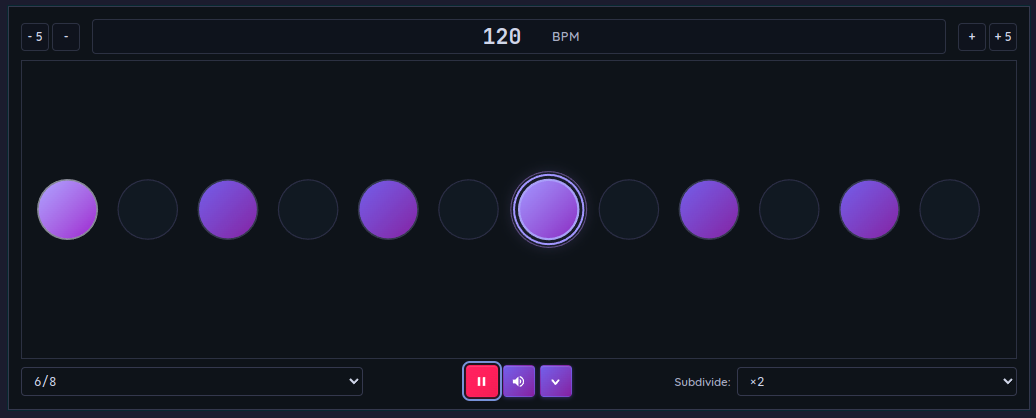
In 6/8, Subdivide Off yields six clicks per bar (once per beat slot). ×2 yields twelve clicks — a finer grid. On the canvas, beat starts and subdivisions are distinguished by color.
Practicing with the Online Metronome
When practicing a song, it's a good habit to identify the time signature first and then set the Online Metronome correctly. Here's a recommended flow:
- Identify the time signature of the song you want to practice (check the score, or analyze the stress pattern by ear).
- Select that time signature in the Online Metronome.
- Match the tool’s beat unit before entering tempo or tapping. In 4/4, tap quarter-note beats. In 6/8, this tool counts eighth-note slots: a score marked dotted-quarter = 60 needs 180 BPM here. Tap each eighth note, not just the two dotted-quarter pulses.
- Turn on the Accent feature and confirm the downbeat position by ear.
- If needed, choose Subdivide (×2, ×3, or ×4) to hear finer rhythmic positions inside each beat slot.
- Start at a tempo 20% below your target BPM and build up gradually.
If you also want to monitor pitch, keep Vocal Pitch Monitor open alongside. You can run rhythm training and pitch training in parallel on the same screen.
For more detail on finding BPM and using tap tempo, see How to Find the BPM of a Song — Tap Tempo Guide.