BPM stands for "Beats Per Minute" — it's exactly what it sounds like: how many beats fall in a single minute of music. It's the universal language of tempo, whether you're reading a score, setting up a DAW, or using a metronome. 60 BPM means one beat per second. 120 BPM means two. That's the whole concept. And yet, once you actually sit down to practice, it's surprisingly easy to lose track — "Am I singing at the right speed? What does this number even mean for my song?" This guide walks through all of it: what BPM really means, how Italian tempo markings map to BPM numbers, general speed ranges by genre, and how singers can actually put a metronome to good use. Pull up MusicalBoard's Online Metronome in your browser while you read — it's handy to try things as you go.
BPM and Tempo — Same Idea, Different Jobs
Tempo refers to the speed at which music moves. BPM is the unit that puts a number on that speed. Saying "this song is slow" describes tempo. Saying "this song is 72 BPM" pins it down exactly.
Why does the distinction matter? Because slow and fast are relative. A tempo that feels relaxed to one person might feel rushed to another. Having BPM as an objective number lets you record and reproduce your practice sessions accurately. You can say "my pitch started drifting at 80 BPM today, so I'll restart from 70 next time" — and mean something precise by it.
The ♩=120 marking at the top of a score means a quarter note falls 120 times per minute.
What Exactly Is a Beat?
To really get BPM, you need a clear picture of what a "beat" is. It's that regular pulse you naturally tap your foot or nod your head to when you hear music. In a song written in 4/4 time, you'd count "one-two-three-four" — each of those counts is one beat. BPM tells you how many of those beats happen in a minute.
Think of a clock's second hand. It ticks at exactly 60 BPM. A song faster than that has beats falling more often than once per second; a slower song has them further apart. Simple as that.
Italian Tempo Markings and Their BPM Equivalents
Classical scores have a long tradition of using Italian words instead of numbers to indicate speed. This goes back to the 17th and 18th centuries, when Italy was at the center of European music — and the convention has stuck ever since. Modern scores often pair Italian terms with BPM numbers, so knowing both systems is genuinely useful.
Here's a rundown of the most common tempo markings, ordered from slowest to fastest. The BPM ranges below are approximate and assume 4/4 time — different sources vary slightly.
| Italian Term | Meaning | Approximate BPM |
|---|---|---|
| Largo | Broad and slow | 40–60 |
| Adagio | Slow and at ease | 55–75 |
| Andante | At a walking pace | 73–85 |
| Moderato | At a moderate speed | 86–110 |
| Allegretto | Slightly fast | 100–120 |
| Allegro | Fast and lively | 120–168 |
| Vivace | Vivacious and quick | 132–176 |
| Presto | Very fast | 168–200 |
One interesting thing: these markings carry a mood, not just a speed. Allegro literally means "merry" or "cheerful" in Italian, not just "fast." That's part of why two performers can interpret the same marking a little differently. BPM numbers help reduce that ambiguity. For a more complete list of tempo terms, Wikipedia's Tempo article is a solid reference.
BPM by Genre — The Speed Spectrum in Numbers
BPM does a decent job of reflecting the character of a genre. There's plenty of variation within any given style, and the same BPM can feel completely different depending on the drum pattern or arrangement — but the general tendencies are real.
On the slower side (60–90 BPM) Ballads, slow R&B, and folk-leaning songs tend to land here. These are genres where the lyrics need room to breathe, and the pace gives each line space to land. In classical singing, the slow movements of arias often fall in this range too. For vocal warm-ups — lip trills, long tones — starting around 60–80 BPM keeps things easy on the voice before it's properly warmed up.
Middle ground (90–120 BPM) A huge chunk of pop lives in this zone. It's also roughly the pace of a comfortable walk, which may be part of why so many songwriters gravitate here when they want something universally accessible. ABBA's Dancing Queen sits at 100 BPM, and plenty of K-pop mid-tempo tracks fall in this range too.
On the faster side (120–160 BPM) Dance-pop, uptempo pop, and energetic rock tracks tend to cluster here. From a vocal standpoint, this is where you start needing to place syllables quickly and cleanly — diction and rhythmic precision become real priorities.
Very fast (160 BPM and above) EDM, drum and bass, and fast rock push into this territory. At these speeds, individual beats are so short that sustaining melodic lines becomes secondary — conveying rhythm and energy takes over.
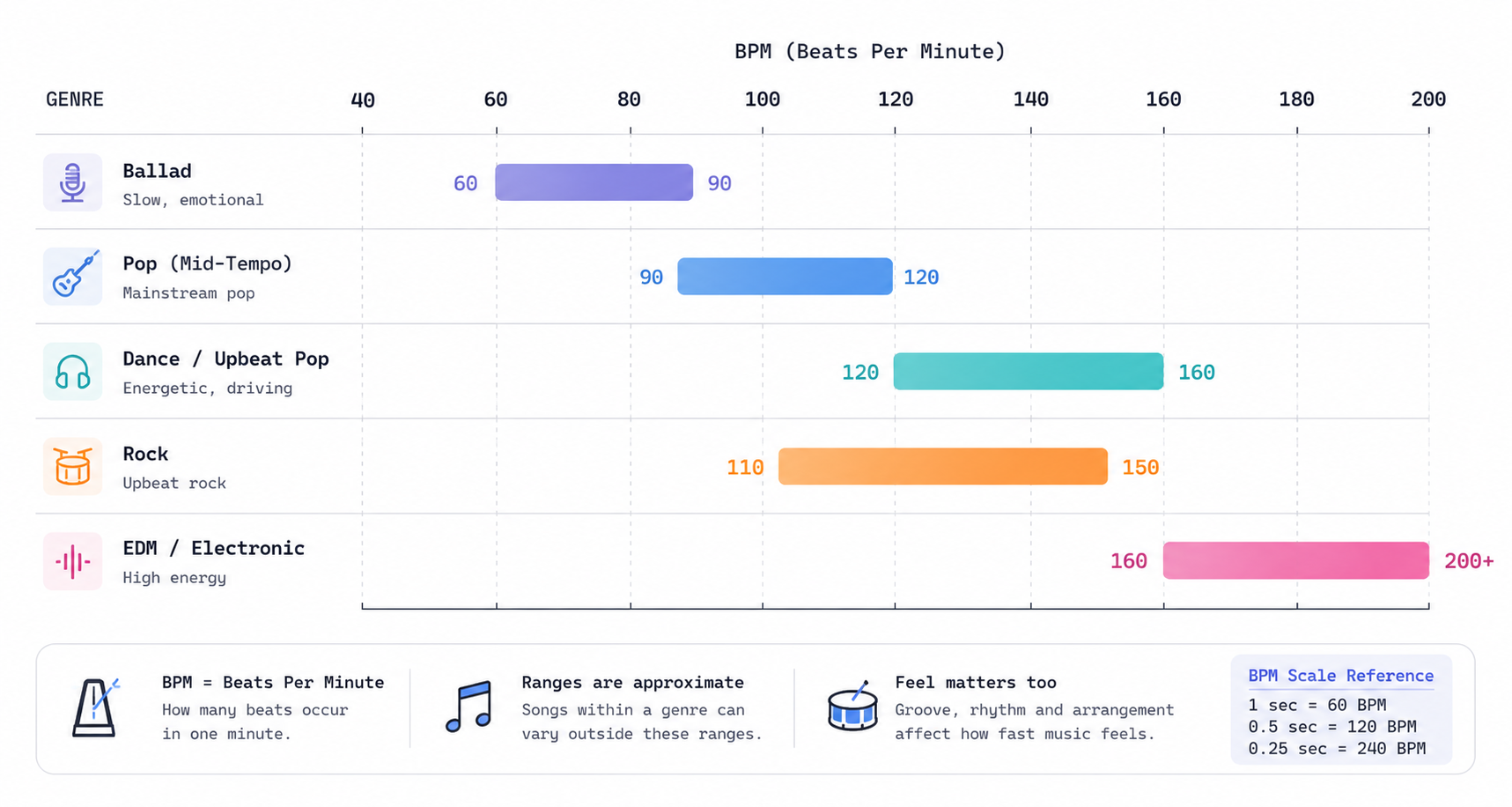
From ballads to EDM, each genre tends to cluster in a particular BPM range.
BPM and Time Signature Are Not the Same Thing
When people first encounter BPM, time signatures often get tangled up with it. They're different concepts.
BPM is about speed — how many beats happen per minute.
Time signature (4/4, 3/4, 6/8, etc.) is about structure — how many beats fit in a measure, and what note value counts as one beat. In 4/4, you get four quarter notes per measure. In 3/4, three.
A simple way to think about it: a waltz is in 3/4 time — you feel "one-two-three, one-two-three" in each measure. But a waltz at 100 BPM feels completely different from the same waltz at 60 BPM. The time signature defines the pattern; BPM defines how fast that pattern repeats.
For singers, this distinction becomes practically important when you're working on a piece in 6/8. That time signature puts six eighth notes in each measure — if you set your metronome as if it were 4/4, your click pattern won't line up with the music. MusicalBoard's Online Metronome lets you choose from 4/4, 3/4, 2/4, 6/8, 9/8, and 12/8, so you can match the actual structure of whatever you're practicing.
BPM for Singers — Practical Tips
Instrumentalists reach for a metronome almost automatically. Singers, on the other hand, often skip it — the thinking being "I'll just play the backing track and sing along." That's not wrong, but without a BPM reference, it's hard to pinpoint exactly where things go off the rails.
The key rule for metronome practice is simple: don't jump straight to the target tempo. Find the BPM of the piece or the original recording, then start 20–30% slower than that. Once your pitch and phrasing feel solid at that speed, bump it up a notch. Repeat until you're at full tempo. By then, your accuracy at speed tends to actually hold up.
For Warm-Ups
Lip trills and humming warm-ups work well around 60–80 BPM. Starting too fast means you're asking your voice to work before it's ready. Same goes for scale exercises — anchor yourself at a tempo where your pitch stays stable, get comfortable there, then move up.
For Drilling Difficult Passages
Running the whole song from start to finish over and over is rarely the most efficient use of practice time. Isolating a tricky two- or four-measure section and working it with the metronome is usually far more effective. If the transition into the chorus keeps giving you trouble, cut out just those two bars and start at 70 BPM. Hit it cleanly ten times in a row, then move to 80. This way, you're not just hoping it'll click eventually — you know exactly which tempo it starts to hold together.
Finding a Song's BPM with Tap Tempo
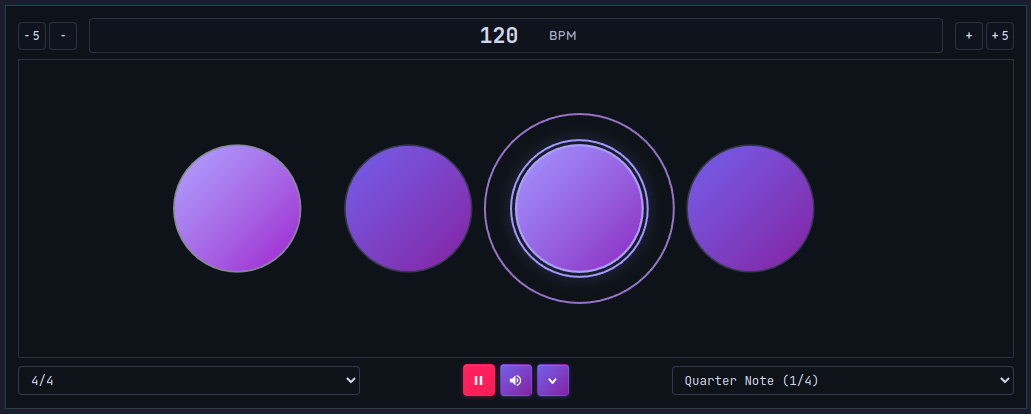
If you want to practice along with a recording but don't know the BPM, tap tempo is your friend. Just tap along to the beat and the metronome calculates the average interval for you. In MusicalBoard's Online Metronome, tapping the BPM display twice or more will lock in the tempo automatically — no separate app needed, just open the browser.
Practicing with MusicalBoard Online Metronome
The Online Metronome runs entirely in your browser — no install, no microphone required. Here's a quick rundown of what it can do:
- BPM control: Adjust from 30 to 300 BPM using -5 / -1 / +1 / +5 buttons.
- Tap tempo: Tap the BPM display to the beat and the average is applied automatically.
- Time signature: Choose from 4/4, 3/4, 2/4, 6/8, 9/8, or 12/8.
- Subdivision: Add eighth notes, triplets, or sixteenth notes within each beat for more detailed rhythmic reference.
- Accent toggle: Emphasize the downbeat of each measure, or turn it off entirely.
- Auto-save: Your BPM, time signature, and subdivision settings are saved to local storage, so your setup is there when you come back.
A few setups that work particularly well for voice practice: for long-tone exercises, try 4/4 at 60–70 BPM and hold one note per beat while focusing on breath management. For scales, switching to eighth-note subdivision gives you a reference point between each note, which tightens up your rhythmic placement noticeably. And if you're working on a 6/8 piece, always switch the time signature to match — otherwise the click pattern won't reflect how the music actually groups.
If you also want to track pitch in real time, keeping the Vocal Pitch Monitor open alongside the metronome is a solid setup. The metronome keeps the pulse; the pitch monitor shows you exactly what your intonation is doing as you speed up.
From Knowing BPM to Feeling It
Understanding BPM doesn't automatically translate into a stronger sense of rhythm. Knowing that 120 BPM is a certain speed and actually singing cleanly on top of it are two different skills — the second one takes real practice. But having BPM as a concrete reference point makes the direction of that practice much clearer. There's a meaningful difference between vaguely sensing "I think I rushed that" and knowing "I sang that 15 BPM faster than the original."
Try not to treat the metronome as just a click track in the background. Use the tempo as a framework to actively think about how you're managing your breath, landing your pitch, and handling the text. Start by looking up the BPM of the piece you're working on today — and go from there.
References: