
Looking at sheet music or listening to an accompaniment, you run into symbols like Am, Cmaj7, and G7 — and plenty of singers have been singing for years without knowing exactly what those mean. A chord is two or more notes sounded simultaneously to create a harmonic unit. Pressing several keys on a piano at once is a chord; striking several guitar strings at once is a chord. Chord knowledge matters for singers because understanding what harmonic structure the accompaniment is moving through makes the placement and direction of the notes you sing far clearer. This article covers chord structure from the ground up — major triads, minor triads, 7th chords, chord notation, and inversions — in a systematic way. Open MusicalBoard's Virtual Piano alongside and play each example as you read; it will stick much faster.
What Is a Chord?
In music, a chord is two or more notes of different pitches sounded at the same time. Two notes together are usually called an interval; three or more notes stacked according to specific rules form a chord. A chord built from three notes is called a triad; a chord built from four notes is called a seventh chord.
The way a chord is built is defined by its intervallic relationships. "Which note do you stack, and how many steps above the root?" determines the character of the chord. That intervallic structure is what makes a chord sound bright like a major chord, or dark like a minor chord.
Major Triad: Bright and Stable
The major triad is the most fundamental chord form. Its construction:
- Root: The reference pitch of the chord
- Major 3rd: Four semitones (two whole steps) above the root
- Perfect 5th: Seven semitones above the root
Using C major as an example:
- Root: C
- Major 3rd: E — four semitones above C
- Perfect 5th: G — seven semitones above C
Press C, E, and G simultaneously on Virtual Piano and you get the C major chord. Its character is bright and stable. Here are some common major triads:
| Chord | Notes |
|---|---|
| C major (C) | C – E – G |
| G major (G) | G – B – D |
| F major (F) | F – A – C |
| D major (D) | D – F# – A |
| A major (A) | A – C# – E |
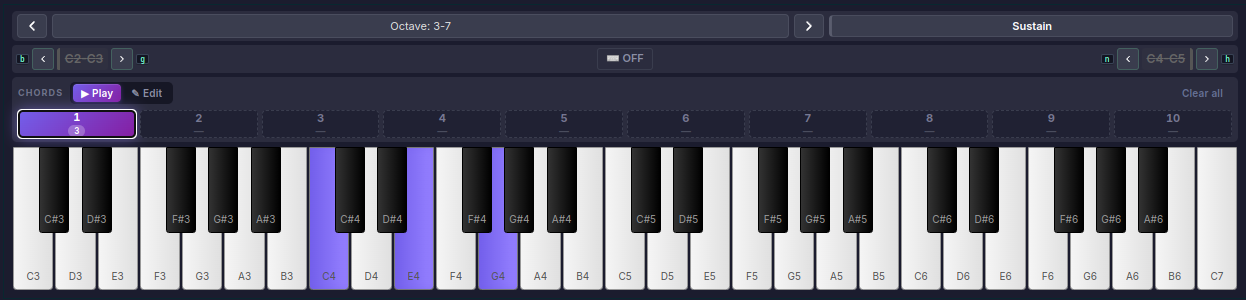
The C major chord consists of three notes: C, E, and G — the root (C) with a major third (E) and a perfect fifth (G) stacked above it.
Minor Triad: Dark and Lyrical
The minor triad shares the perfect fifth with the major triad but lowers the third by one semitone.
- Root: The reference pitch of the chord
- Minor 3rd: Three semitones above the root
- Perfect 5th: Seven semitones above the root
Using A minor as an example:
- Root: A
- Minor 3rd: C — three semitones above A
- Perfect 5th: E — seven semitones above A
Press A, C, and E together on Virtual Piano and you get A minor. The character is darker and more lyrical than a major triad — a sound that appears frequently in pop ballads.
| Chord | Notes |
|---|---|
| A minor (Am) | A – C – E |
| E minor (Em) | E – G – B |
| D minor (Dm) | D – F – A |
| B minor (Bm) | B – D – F# |
The only difference between a major and a minor triad is whether the third is one semitone higher or lower. Yet that one semitone changes the entire impression of the sound. Play C and then Cm back to back and the contrast is immediately audible.
Diminished and Augmented Triads: A Brief Overview
Beyond major and minor triads, there are also diminished triads and augmented triads.
A diminished triad stacks a minor third on top of another minor third: root – minor 3rd – diminished 5th. The sound is tense and unsettled. Example: B diminished (Bdim) = B – D – F. This chord often appears in harmonic progressions to create tension.
An augmented triad stacks a major third on top of another major third: root – major 3rd – augmented 5th. The sound is unstable and slightly surreal. Example: C augmented (Caug) = C – E – G#. It is used to express the tension just before a harmonic resolution.
These two chords do not appear as often in everyday pop and contemporary music, but knowing them is helpful for understanding harmonic structure.
7th Chords: Major 7th, Minor 7th, and Dominant 7th
Adding one more note — a seventh interval — on top of a triad produces a seventh chord. Seventh chords sound richer and more complex, and they appear very frequently in jazz and pop. Here are the three most commonly encountered types.
Major 7th Chord
A major 7th stacked on top of a major triad. Notation: maj7 or M7.
- C major 7 (Cmaj7) = C – E – G – B
- Character: warm and polished. Frequently found in K-pop and jazz-pop.
Press C, E, G, and B together on Virtual Piano for Cmaj7.
Minor 7th Chord
A minor 7th stacked on top of a minor triad. Notation: m7.
- A minor 7 (Am7) = A – C – E – G
- Character: soft and emotive. Common in pop ballads.
Dominant 7th Chord
A minor 7th stacked on top of a major triad. Notation: the number 7 alone. This chord creates the strongest sense of tension and a feeling of waiting for resolution.
- G7 = G – B – D – F
- Character: strong tension and a powerful pull toward the next chord. The satisfaction of resolving to C major is especially pronounced.
The dominant 7th chord appears very frequently in harmonic progressions as the "V7 → I" pattern. The G7 → C major progression is the classic example.
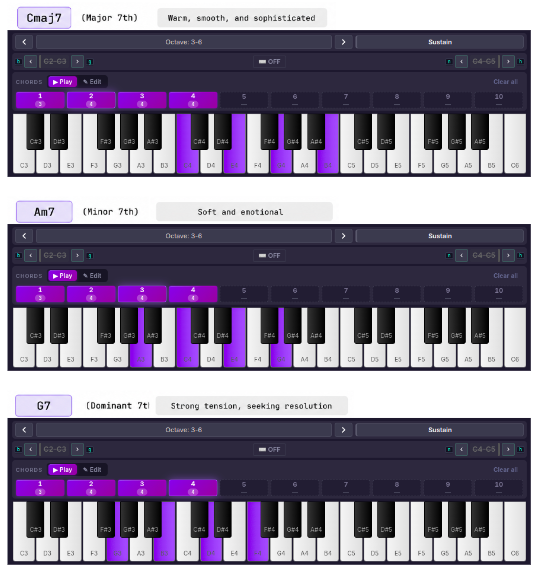
A seventh chord adds one note to a triad, making the sound noticeably richer. Compare the notes of Cmaj7 (major 7th), Am7 (minor 7th), and G7 (dominant 7th).
Chord Notation: How to Read Am, Cmaj7, and G7
Chord symbols are built from a few consistent rules.
Root note: Written as an uppercase letter — C, D, E, F, G, A, or B. Sharp: A # or ♯ symbol after the letter. C# = C raised one semitone. Flat: A b or ♭ symbol after the letter. Bb = B lowered one semitone.
Quality notation:
- Nothing added = major triad. C = C major.
- m or min = minor triad. Am = A minor.
- maj7 or M7 = major 7th chord. Cmaj7 = C major 7th.
- m7 = minor 7th chord. Am7 = A minor 7th.
- 7 alone = dominant 7th chord. G7 = G dominant 7th.
- dim or ° = diminished triad. Bdim = B diminished.
- aug or + = augmented triad. Caug = C augmented.
Examples you will encounter on sheet music and chord charts:
- F#m = F# minor (F#, A, C#)
- Bb = Bb major (Bb, D, F)
- Em7 = E minor 7th (E, G, B, D)
- Dmaj7 = D major 7th (D, F#, A, C#)
Once you are fluent in reading chord symbols, you can decode the harmonic structure of a song from a chord chart alone, without sheet music.
Chord Inversions: Same Notes, Different Arrangement
A chord inversion rearranges the notes of a chord. The notes remain the same, but a different note moves to the bottom.
Root position: The root is on the bottom. Example: C major = C (bottom) – E – G (top).
First inversion: The third is on the bottom. Example: C major first inversion = E (bottom) – G – C (top). Notated as C/E or with a slash symbol.
Second inversion: The fifth is on the bottom. Example: C major second inversion = G (bottom) – C – E (top). Notated as C/G.
Using inversions keeps the chord the same but smooths the bass line. For example, in a C – Am – F – G progression, changing F to F/C (second inversion) turns the bass motion into C – A – C – G, making the progression sound considerably smoother.
For singers, inversions matter because the lowest note of the accompaniment changes depending on which inversion is used, and that affects the color of the melody notes above it. Once you understand basic chord structure and add inversions to your knowledge, you start being able to identify by ear which note the bass is on — a meaningful step in ear training.
Why Singers Need to Know Chords
The question of whether singers need chord knowledge comes up often. The assumption is that singers do not need to play piano or guitar. But chord knowledge has a direct impact on vocal performance.
Understanding your position in the harmony: Knowing which chord is sounding tells you whether the note you are singing is the root, the third, or the seventh of that chord. This positional awareness makes it much clearer how stable your note is within the harmony and in which direction it needs to move.
Fitting into the accompaniment: Understanding chord progressions tells you which notes are harmonically stable on each chord and which are unstable. This becomes direct guidance for choosing pitches when improvising or adding melismas.
Understanding the key: Identifying the key through the chord progression makes it easy to calculate how many semitones to raise or lower when transposing to suit your voice.
Hearing chord changes: With a foundation in chord basics, you begin to hear when chords change while listening to the accompaniment. This is an important stage in ear training.
Playing Chords on MusicalBoard Virtual Piano
MusicalBoard's Virtual Piano opens in the browser and lets you press chords directly with mouse clicks or screen touches. It uses the Web Audio API to produce sound, so no app installation is needed.
Practical ways to learn chords on Virtual Piano:
Building ear memory for basic triads: Press C, F, and G major, then Am, Dm, and Em in sequence. Hearing the difference between major and minor directly is far more effective at building recognition than reading theory alone.
Comparing 7th chords: Press Cmaj7, then G7. Then repeat the G7 → C major progression several times. The pull of a dominant 7th resolving to a major chord is something your ear will remember.
Using chord slots: Virtual Piano's chord slot feature lets you save frequently used chords and play them with a single button. Saving Am, F, C, and G — the four core chords of C major — into slots makes practicing chord progressions much more convenient.
Comparing inversions: Press C major in root position (C-E-G), then first inversion (E-G-C), then second inversion (G-C-E) in order. The sonic difference between the same chord in different inversions is immediately apparent.
After learning chords on Virtual Piano, combining it with Vocal Pitch Monitor multiplies the benefit. Sound a chord on Virtual Piano and sing scales or a melody over it while Vocal Pitch Monitor confirms your pitch accuracy. Also, running Vocal Range Test first to map your range gives you a reference for which octave feels most natural when practicing over chords.

Saving your most-used chords into slots means you never have to hunt for the keys during chord progression practice.
The Next Step After Learning Chords
Once you have a handle on basic triads and 7th chords, the next step is practicing chord progressions. Music gravitates toward familiar patterns. The I-V-vi-IV progression (C-G-Am-F in C major) is one of the most common patterns in pop and contemporary music. The ii-V-I (Dm7-G7-Cmaj7) progression is the cornerstone of jazz.
The most effective way to internalize the relationship between chords and your voice is to play these progressions on Virtual Piano and sing over them. Content that is abstract in theory becomes concrete and tangible the moment your fingers press the keys.
Chords can feel intimidating at first, but once you grasp the basic structure — root + 3rd + 5th — everything else is a variation of that idea. Major third or minor third; major 7th or minor 7th. Remember that those two binary choices determine the character of any chord, and even an unfamiliar chord symbol becomes easy to analyze on the spot.